MI-robot: viewing tumors


How can technology help us to view cancerous tumors faster and better, thus saving lives? In this podcast episode of AI for Life, we are introduced to the MI robot. Radboudumc, Soteria Medical and Tesla Dynamic Coils are working together in this project to develop a robot that can take more targeted biopsies, using an MRI guided needle and antenna. We will discuss how to detect and identify tumors, and what the robot will mean for patient and professional. This new podcast is with:


Tom Scheenen from Radboudumc;
Gerrit Tigelaar of the company Soteria Medical;
And Thomas Meurs of the company Tesla Dynamic Coils.

Listen to the podcast (in Dutch)

Kadans Building the Future episode 5: Your next doctor will be a robot

If there is one area where technological developments are introduced at a rapid pace, it is the medical sector. A growing number of medical procedures are already being performed by robots and other forms of hyper-intelligent technology. Is this the beginning of an era where doctors are superfluous? Host Rudy van Beurden tries to find out.

Therefore he has invited three health experts: Bram de Beer from Eindhoven Medical Robotics, Jasmijn Kok from Juno Perinatal and Roel Boumans from Behavioral Science Institute (BSI) Radboud University.

Listen to Building the Future now, for example on SpotifyApple Podcast or YouTube.

Digital Health is thriving in the Nijmegen region, where it contributes to better care and health and also creates jobs.The corona pandemic underscores the importance of digital solutions, such as image calling and telemonitoring, for care and health. To bring developers and end users even closer together, The Economic Board and the Radboudumc are introducing the Interactive Digital Health map.


Nice ecosystem

Nijmegen is known for its large healthcare sector: no less than a quarter of the working population has a job in healthcare or a sector directly related to it. Specifically for Digital Health, a lot of knowledge and skills (human capital) are present at the Radboudumc, the Radboud University, the University of Arnhem and Nijmegen (HAN) and the ROC Nijmegen. More than 50 companies are also active in Nijmegen and the surrounding area in the field of Digital Health. Various financing options exist for Digital Health innovations and business support is also available. So there is already a nice ecosystem in place that offers plenty of opportunities for further expansion.


Read more about this cooperation between Radboudumc and The Economic Board.

Last week we successfully connected 16 ecosystems within CVN, resulting in more than 30 1-to-1 sessions between corporates and SME’s/startups around the theme ‘Health(care) and Life Science. Many of them will also have a follow-up meeting.


The three CVN regional ecosystem partners (LIOF, BOM and OostNL) together with TNO, IMEC iStart, Brightlands Maastricht Health Campus, NLC Health and RWTH provided unique access to the innovations and technologies/services of 42 SMEs/startups in their portfolios that were relevant to the specific and latent challenges of 6 CVN corporates (Achmea, ASML, FUJIFILM, Medtronic, Philips and Unilever). The SMEs/startups can on their part benefit from the facilities, know-how, competencies and ecosystem of the corporates to boost their innovations. More than 50% of the SME’s/startups were invited to have a 1-to-1 conversation with the corporates and over 20% of them had a conversation with more than one corporate. The regional ecosystem partners are committed to further support “their” startups/SMEs with collaborations with the corporates.


To facilitate the information flow between the startups/SMEs and the corporates to prepare for the meeting, we used an innovative collaboration platform: Klever. Klever provides startups/SMEs a better way to tell their story and convey your proposition to the corporates and provides corporates a good insight into the capabilities of the startups/SMEs. The platform also enables corporates to involve relevant decision-makers internally and externally to optimize their decisions. (youtube about the event and Klever: click here; opening slides are on the CVN member page).


This event is not an isolated activity. As CVN, we are investigating how we can increase our ability to connect our members and partners’ ecosystems and foster collaboration, thereby creating more value for our members. How can we make better use of the wisdom of the CVN cloud, e.g., by using data-driven solutions such as the Klever platform?


What are the next steps? We are planning to have interviews with both the CVN members involved in the event of July 14th as well as several other CVN members that have expressed their interest in a similar event around the theme energy transition. Based on this input, we will prepare a plan that will be presented to the CVN members in a meeting in September (date to be set). More than ten years ago, we started as a platform for sharing good/bad practices. The next step has been to become an association of Corporate Venturing professionals (e.g. by creating the Corporate Venturing & Entrepreneurship Community and conducting research). We think that the next step in our CVN journey is collaboration and co-creating between ecosystems.

Last week, three start-ups and scale-ups presented their investment plans at the Business Angels Network Nijmegen, which was set up three years ago by the Business Angels Network East NL team and others. Besides the interest in the pitches, the angels also meet to make mutual contacts and gain investment knowledge.


Planon

Successful Nijmegen entrepreneur Pierre Guelen (Planon) talked about the growth spurt of his company and the challenges he experienced in the first five years. He now runs a global facility management software company and has recently built his own campus for start-ups.


Aeternus

Aeternus as a new partner then gave an interesting story about valuing start-ups. What language do you have to speak and which elements of a valuation are important? Tips and tricks from practice were passed in review.


About Business Angels Network Nijmegen

Business Angels Network Nijmegen is the network of angel investors that strengthens the ecosystem of Nijmegen start-ups and scale-ups (Health and High Tech). The network brings together the angels and the selected and prepared start-ups and scale-ups on a regular basis. Other partners are Briskr, The Economic Board, Rabobank, BDO, Poelmann van den Broek, EP&C, Aeternus, Rockstart and the municipality of Nijmegen.

By now, a group of 60 active angels have joined our network and in the past 3 years we have “triggered” around €2.5 million in investments from these angels and other financiers/investment funds.


If you are a business angel and interested to join this network, please contact Martijn Kriens or Bart Heuts for more information


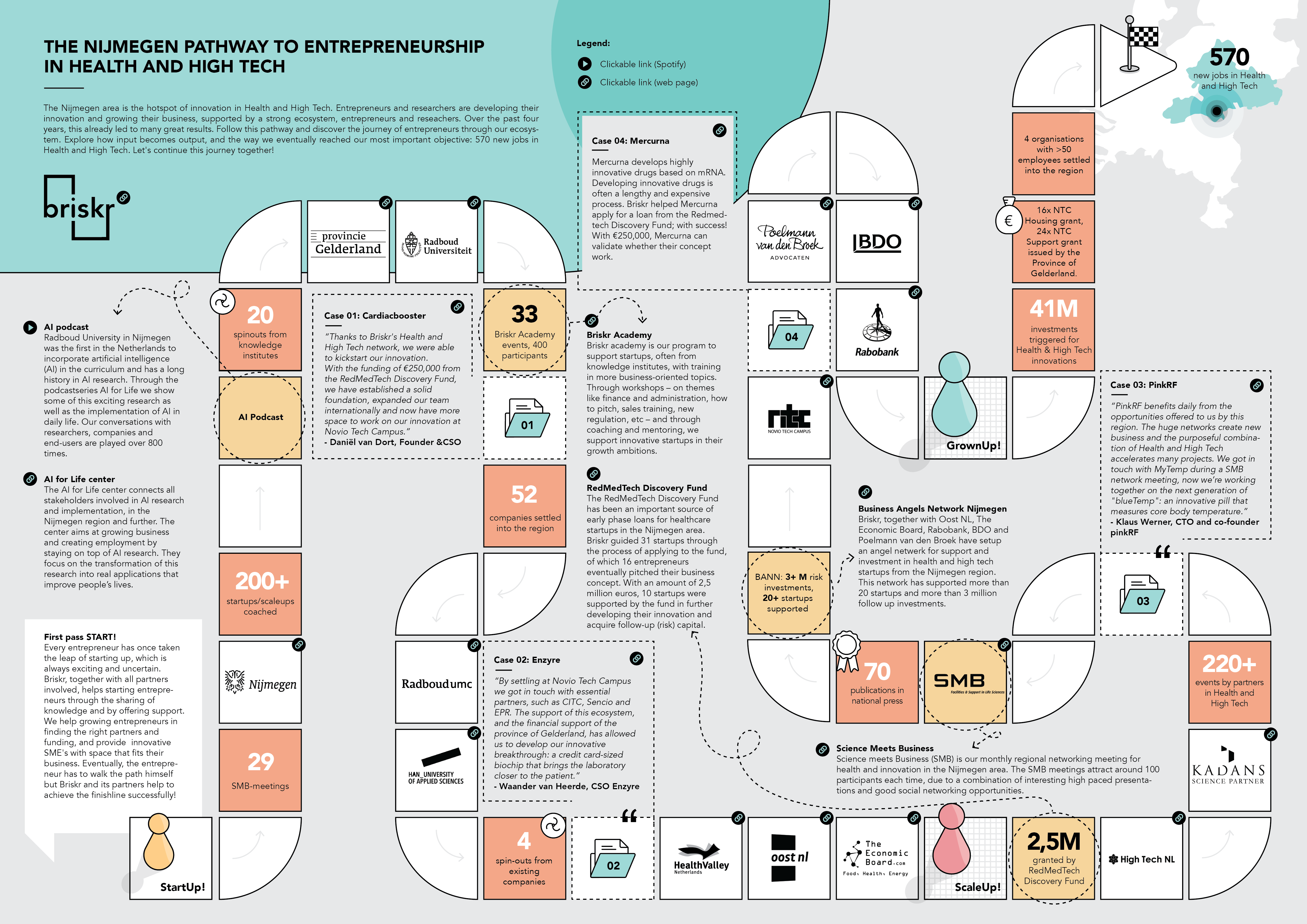
The Nijmegen area is the hotspot of innovation in Health and High Tech. Entrepreneurs and researchers are developing their innovation and growing their business, supported by a strong ecosystem. Over the past four years, this already led to many great results. For the next years we want to build upon this foundation to further accelerate ofinnovative entrepreneurship for the region to grow the regional economy and create a societal impact.

Together with our partners and, most importantly, the entrepreneurs in our network. Follow this pathway and discover the journey of entrepreneurs through our ecosystem. Explore how input becomes output, and the way we eventually reached our most important objective: 570 new jobs in Health and High Tech. Let’s continue this journey together!

Download the Nijmegen pathway as pdf file


The subject of this broadcast is computational pathology. Artificial Intelligence to support the radiologist has of course been around for a long time and is starting to be introduced more and more into daily operational processes. Think of software for scanning and analysing lung scans to detect cancer. But the use of AI in pathology has some additional challenges. For instance, pathologists are not always used to a digital workflow yet, and they use a microscope more often than smart software. In addition, the costs of implementing a digital workflow are high. Yet AI offers great opportunities to improve the quality of tissue research and make the process more efficient. The speakers in this podcast aim to make great strides in implementing and supporting the digital workflow for pathologists in the coming years.


We do so with:

– Katrien Grundberg, head pathology department Radboudumc;
– Jeroen van der Laak, researcher computational pathology at Radboudumc
– and Patrick de Boer, co-founder of patholyt, a start-up based on knowledge developed at Radboudumc.


Listen the podcast.

Start-up CardiacBooster is developing a small but powerful pump that can pump blood through the groin of a patient’s heart. The device helps cardiologists in the critical phase shortly after a heart attack. A heart attack damages the heart muscle. In some patients (about 5 percent) this results in less blood being pumped around the body. The result is that organs receive too little blood. This can cause them to function less well. Sometimes, this can even be so bad the patient dies as a result.


Kind of balloon
“Our device works like a balloon that can suck in and push out blood,” says Daniël van Dort, inventor of the technology and Chief Science Officer and co-founder of CardiacBooster, a spin-off of the Radboudumc in Nijmegen. “You improve the strength of the heart with this pump and can pump more blood around.” People with a severe infarction for example, relatively often suffer kidney damage, requiring dialysis. By using the device, this kidney damage can be limited. This significantly improves the quality of life of these patients.


Simple insertion
There are other devices that can pump the patient’s blood. But they are relatively large for the amount of blood they can pump. “Unique to our device is that it is easily inserted into patients’ hearts via the groin,” says Van Dort.
The pump can be used there immediately. It can also be used preventively in patients who have a poor heart function and who have to undergo surgery. Van Dort: “You can prevent someone from going off the deep end and suffering damage to their organs because not enough blood is pumped around during the operation.”


Idea book
As a medical student, Van Dort was already fascinated by the workings of the heart. “In the lecture hall, I kept a notebook of ideas in which I wrote down medical problems that I wanted to solve. For example, during my studies I learned that people with a heart attack are given medication to limit the consequences. I found that fascinating: you are trying to solve a mechanical problem, a heart that is not working properly, with a lubricant. Couldn’t you make the heart work better? After my studies, I started to work on this. It literally happened at the kitchen table. So now, five prototypes later, we have a device that can tackle the mechanical problem much better. In addition to his work for CardiacBooster, Van Dort works as a researcher at the Department of Cardiac Surgery of the Radboudumc.


Best Startup
CardiacBooster was founded in 2018. Florian Ludwig from Thuja Capital hooked up as CEO. To develop the product, CardiacBooster received a financial injection from Thuja, the Radboudumc and the RedMedTech Discovery Fund in recent years. This is a fund for innovative start-ups in Life Sciences & Health in Gelderland. In 2019, CardiacBooster was named one of the ten best scientific start-ups in the Netherlands. The company is based at the Novio Tech Campus in Nijmegen.


First study in humans
At the moment, the pump is still being studied in laboratory animals. If all goes well, the first study in humans will take place next year. There are already ten people working at CardiacBooster and the company is looking for further funding. “I know a lot about how the heart works and how to make the blood pump around better. But if you really want to understand how it works, it takes a lot of time and money to research.” By 2023, CardiacBooster hopes to bring this innovation to the market, once approved.


The copywright of this article lies with Innoavtions Origin.


We organized the Briskr workshop’ Trends & developments in the medical sector in China: business opportunities for the Netherlands on May 31.  This session interactively addressed the Chinese demand for Dutch products and technology and highlighted steps Dutch companies can take in order to do business with China.


Judith van de Bovenkamp, OostNL, kicked off this meeting on the trends and developments in the medical sector in China. She explained how Go4export can support you in doing business abroad. For example export vouchers are available for entrepreneurs, you can participate in a trade mission or visit an international fair. Judiths tip: Learn from the experiences of other entrepreneurs and make use of the international network. this way, you can prepare yourself well in doing business with China.


The second speaker was Nico Schiettekatte, from the Dutch Embassy. He informed us that the ministry can support entrepreneurs who want to do business with China in sectors such as pharma, medical devices & health. And he gave an overview of facts and figures in medical markets. The ministry can help you in finding reliable contacts, partners and events (from contact to contract!). There are several offices of the Dutch government in China to help you on the spot.


In the final part, Reinout van Malenstein, HFG IP Firm Shanghai explained us that it is necessary to register your IP. There are some important things you have to know to protect your trademark in China. There are differences between trademarks and patents in Europa and in China.  You need to register it also in China, otherwise you do not have any protection. Even if you do not (yet) have any trade in China, you have to register in China. As European rights will not work in China.


We closed this workshop with a Q&A and online networking. This is the first in a series of workshops on doing business (far) abroad. More countries/dates will be communicated shortly.

Presentation Judith van de Bovenkamp, Project Manager International, Oost NL

Presentation Nico Schiettekatte, attaché Volksgezondheid, Welzijn en Sport

The recording will follow soon.


The MDR workshop took place yesterday. Anja Wiersma from Mi-ce was the speaker who informed the participants about the impact of the new MDR for medical devices. She led us through the major and relevant changes on regulations for medical devices and IVD Products.


Topics like MDR timelines and Changes to classification were covered. And at the request of the attendees Anja got into depth on the following three topics: Clinical evaluation process: (What is enough data? How to gather the data?), Post Market Surveillance process (including PMS plan, PSURs, PMCF) and Eudamed/UDI.


It was a very diverse group of participants, from app developers to suppliers and manufacturers of medical devices. As all participants have to deal with these changes in their organisation and how they each have to be compliant in their own way with the new MDR regulations. We thank Anja for this very informative session!

If you were unable to attend, you can view the workshop with a great deal of practical information about the new MDR here.