Op 5 maart 2026 organiseert het Digital Health Challenge Lab een middag waarin zorgpartners, innovators en andere geïnteresseerden samenkomen. Tijdens het event op Noviotech Campus draait het om matches leggen en laten zien hoe challenge based innoveren in de praktijk werkt. Daarnaast kunnen nieuwe partners ontdekken: hoe maak je van een breed zorgvraagstuk een concrete innovatiechallenge waar je echt mee verder kunt?
Voor veel zorgorganisaties zijn de opgaven helder. De route ernaartoe is dat vaak niet. Juist daar ligt de rol van het programmateam van DHCL, met open innovatie adviseur Maurits van Schaik van Starthubs als aanjager van het challengeproces. “Vanuit beleid kennen we de uitdagingen, maar om tot een goede innovatiechallenge te komen, heb je praktijkinzichten nodig”, vertelt hij.
Daarom voert het team knelpuntgesprekken met onder meer wijkverpleegkundigen, wijkadviseurs en opbouwwerkers. In die gesprekken staat één ding centraal: waar loopt de praktijk echt op vast? Die input is verzameld in een knelpuntenkaart die nu de basis vormt voor nieuwe challenges. “Bij mij mogen mensen een uur lang leeglopen. Dat leverde een sterk overzicht op van waar professionals en bewoners in de wijk tegenaan lopen.”
Knelpuntenkaart als startpunt voor samenwerking
Met een knelpuntenkaart wordt focus aangebracht. Uit de eerste inventarisatieronde zijn zes tot zeven kernproblemen naar voren gekomen. Daarmee ontstaat voor partners een concreter vertrekpunt. Maurits: “Als je een uitdaging omdenkt naar een open innovatiekans, wordt het visueler en concreter. Dan kun je ook beter kiezen waar je samen op inzet.”
5 maart: van online selectie naar echte match
Op 5 maart zetten we een volgende stap in de huidige ronde. Zorgpartners hebben online al voorstellen van ondernemers bekeken en beoordeeld. Tijdens het matchmaking event volgen verdiepende gesprekken om te bepalen wie met elkaar verder gaat. “Met speeddategesprekken van twintig minuten tussen zorgpartners en ondernemers.”
Die gesprekken zijn bedoeld om te toetsen of er inhoudelijke klik is, en of een oplossing past bij de oorspronkelijke uitdaging. Daarnaast zijn ook nieuwe partners uitgenodigd om kennis te maken met de werkwijze van DHCL en te zien hoe het voortraject tot stand komt.
Ook voor nieuwe partners een inkijk in de aanpak
Nieuwe organisaties krijgen zo een inkijk in de methode, de betrokken partijen en de keuzes die voorafgaan aan een succesvolle challenge. “De dag is er ook om te laten zien hoe wij werken: welke vragen je stelt in knelpuntgesprekken, hoe je informatie ophaalt en hoe je dat vertaalt naar een challenge.”
Volgens Maurits zit daar de kern van de aanpak: de taal van zorg en welzijn vertalen naar een heldere vraag voor ondernemers. Dat vraagt afstand, structuur en een frisse blik van buiten. “Een goede challenge maakt een oplossing kansrijk. Geen goede vraag, is geen goed antwoord.”
Programma in het kort
Wanneer? 5 maart 2026
Tijd? 14.00 tot 17.00 uur
Waar? Noviotech Campus, Nijmegen
De bijeenkomst is bedoeld voor huidige partners, nieuwe partners, innovators en organisaties die willen aanhaken bij praktijkgedreven digitale innovatie in zorg en welzijn.
Like the legendary Heracles, who overcame seemingly impossible challenges, Johnson & Johnson joined forces with twelve stakeholders in the Netherlands to unlock the value of patient data. By enabling reuse of oncology data across organizations, these stakeholders aim to improve cancer care through evidence generation for earlier detection and treatment, optimized treatment timing, more personalized care, and reduced healthcare costs.
Three years after the HERACLES* project launched in October 2022, experts from three participating organizations sat down with us to reflect on the project and discuss how their learnings have advanced the shared goal of improving healthcare for cancer patients in the Netherlands and beyond.
Participants:
Merle Bootsma – PhD Candidate, Radboud university medical center (Radboudumc)
Prof. Dr. Jildau Bouwman – Senior Scientist, TNO, and Professor, Leiden University
Ton Peters – Associate Director, Evidence Generation,Johnson & Johnson Innovative Medicine Benelux
The challenge: Data fragmentation and privacy fears
In the Netherlands, healthcare datasets are fragmented across numerous registries and institutions, stored in diverse formats, and marked by duplication and inconsistent standardization.
Additionally, concerns about patient privacy have grown in the Netherlands, fueled by recent data leaks. At the same time, biotech companies are concerned with protecting their intellectual property, and academic researchers worry that sharing data too early could limit publication opportunities.
Data fragmentation and privacy concerns complicate the implementation of FAIR-data principles in the data environment, where data should be findable, accessible, interoperable, and reusable for a learning healthcare system that uses health data to drive continuous, evidence-based improvements in care.
With the aim to achieve all these goals and to create patient value that extends beyond traditional clinical trial results, stakeholders from academic institutions, healthcare data registry holders, health insurers, innovative organizations, biotech companies, and patient advocacy groups chose to participate in HERACLES to work towards the shared goal of using patient data to support decisions that drive better outcomes.
The shared goal of HERACLES is to support more efficient research by enabling the sharing and reuse of data from multiple sources to create larger datasets. This will allow researchers to analyze a higher volume of real-world datapoints across a wider range of elements, including treatment follow-up information, to generate relevant medical insights for patients, caregivers and policy makers.
A difficult but necessary step forward
The stakeholders collaborating in HERACLES understood the importance of resolving the data fragmentation and accessibility barriers to achieve better healthcare outcomes for patients. To this end, the HERACLES project aimed to develop a privacy-by-design data infrastructure that would enable the analysis of large, standardized datasets while allowing organizations to retain custodianship and full control of their data by residing in their own systems. They focused on use cases in lung cancer and ovarian cancer to assess how using larger federated datasets could answer important healthcare questions.
Diverse expert perspectives on HERACLES
HERACLES united leading voices from the biomedical field, allowing challenges to be tackled collectively and giving everyone a clearer understanding of goals, issues, and outcomes across different areas.
“At Radboudumc, we wanted to answer important oncology research questions, but the available healthcare data was too fragmented and often lacked key follow-up details, such as changes in chemotherapy regimens. Through HERACLES, we were able to identify what is needed for reliable, standardized data reuse without increasing the burden on clinicians.”
– Merle Bootsma, PhD Candidate, Radboudumc
“At TNO, we sought to develop new data-driven innovations and diagnostics but faced the same challenges with fragmented and incomplete healthcare data. We explored how emerging technologies such as privacy-enhancing-technologies and data spaces could help overcome these barriers.”
– Dr. Jildau Bouwman, TNO
“At Johnson & Johnson, we aimed to better understand which healthcare variables influence treatment outcomes and whether deeper data analysis could support more informed decisions, such as early detection of lung cancer and initiating treatment earlier to improve health outcomes for patients. We were also interested in assessing whether these real-world questions could be effectively addressed within the Dutch healthcare system.”
– Ton Peters, Johnson & Johnson
Outcomes: Obstacles and insights
The HERACLES project found that data quality and compatibility remain major obstacles to integrating Dutch healthcare data. For example, Merle Bootsma observed that “merging datasets reduced the number of usable patient records from about 1,500 to just 90 for analysis”, while Ton Peters noted that “Dutch healthcare datasets do not currently align with FAIR principles.”
HERACLES confirmed that technology alone isn’t enough—and that data quality and alignment are the real bottlenecks. That clarity is now shaping the next phase of work toward a scalable, federated approach. According to Jildau Bouwman, “the project has delivered meaningful deliverables and intermediate outcomes that will benefit the continued development of a learning healthcare system in the Netherlands.” With additional, more focused effort, its objectives are well within reach.
Key lessons from HERACLES include the need for data to be captured with sufficient quality and standardization for federated data combinations to deliver enough usable data points to answer specific research questions. In addition, the right combination of emerging technologies, such as privacy-enhancing technologies and data spaces, and strong governance can make health data more accessible for reuse. Participants emphasized the importance of capturing all relevant information at the point of data registration and the value of being able to estimate the number of usable data points before seeking ethical approval.
Toward a learning healthcare system in the Netherlands and beyond
To date, HERACLES has enabled stakeholder alignment on a shared vision for a federated privacy-by-design system for automated integration of detailed healthcare data to drive research, innovation, and personalized patient care. The HERACLES partners have shared their insights with the Dutch Ministry of Health and other healthcare organizations and continue to collaborate to overcome remaining barriers. Johnson & Johnson believes HERACLES will help establish a practical framework for the European Health Data Space initiative and improve healthcare outcomes in the Netherlands and beyond.
We would like to express our sincere thanks to our fellow HERACLES partners: IKNL, Stichting Radboud universitair medisch centrum, UMC Groningen, AstraZeneca BV, Roche Nederland BV, Almende BV, Linksight BV, Pharmo Institute NV, SURF BV, CZ Zorgverzekeringen NV, Stichting Olijf, and TNO, for their valuable collaboration and commitment.
Appendix: Main conclusions of the HERACLES project
Data quality starts at the source: High-quality data must be captured once, in a structured way, at the point of origin. Standardizing data according to international definitions enables easier and more efficient reuse, without adding administrative burden to healthcare providers.
Patient-centric data is lacking: Many datasets are process-driven rather than patient-focused, making them unsuitable for a learning healthcare system. Limited clinical data from the patient perspective hinders understanding of the full care pathway—from GP visits to pharmacy, treatment, and aftercare.
Coverage issues in combined data: When merging datasets from multiple sources for the same patient group, coverage quickly becomes insufficient because no source has 100% completeness. In HERACLES, less than 10% of useful information remained after integration—a problem that only became clear after significant effort.
Legal and organizational barriers to data linking: Despite technical solutions like data spaces and privacy-enhancing technologies, linking data remains challenging. HERACLES demonstrated that combining dataspace standards with encryption can enable privacy-preserving analysis, but this requires investment and legal expertise, which are often lacking.
Need for better data discoverability and context: Researchers need early insight into how much data will be available when combining sources. Current FAIR principles focus on descriptions and usage conditions, but not on indicative data volumes. Knowing this upfront—and understanding the context of each source—can save time and ensure correct analysis.
Further details can be found in the interim report which is available (in Dutch only) through this link.
* HERACLES stands for HEalth ReseArch – Cancer Living labs – setting up an Ecosystem of trust (Secure and Sovereign)
De eerste concrete resultaten van het Digital Health Challenge Lab (DHCL) zijn binnen! DHCL is een vooruitstrevend open innovatieprogramma waarin partners uit wonen, zorg en welzijn samen met innovatieve startups, scale-ups en mkb vernieuwende oplossingen ontwikkelen voor maatschappelijke uitdagingen op het gebied van zorg en welzijn. Zo ontstaan oplossingen die direct aansluiten bij werkelijke problemen van zorgorganisaties en hun cliënten. Vijf organisaties staan nu klaar om met hun oplossingen écht impact te maken in de zorgsector. In dit artikel nemen we je mee in de samenwerkingen die het afgelopen jaar zijn ontstaan.
We4U | Open Call 100@home: van mantelzorg probleem naar sociale netwerkoplossing Tijdens de open call stond de vraag centraal: ‘hoe kunnen we ervoor zorgen dat ouderen langer, gelukkiger en zelfstandiger thuis kunnen blijven wonen’. Via de open call, waar Vivare, Volkshuisvesting en Talis onderdeel van waren, ontstond een match met We4U. We4U had een innovatieve oplossing die de druk op mantelzorgers kan verlichten en tegelijkertijd de autonomie van hulpvragers versterkt. De oplossing werd een app die informele zorg organiseert binnen bestaande sociale netwerken. Deze innovatieve oplossing maakt het voor bewoners eenvoudig om hulp te vragen voor dagelijkse taken, terwijl familie, vrienden en buren zelf kiezen welke taken ze oppakken. Dit hybride model van formele en informele zorg leidt tot kostenbesparingen en versterkt het sociale vangnet. In 2026 start de pilot met Vivare. We4U benadrukt de waarde van het traject: “Onze deelname aan DCHL heeft ons veel opgeleverd. Het traject heeft mij inzicht gegeven in hoe het werkt bij grotere organisaties en ik heb veel interessante connecties opgedaan.
VindiQu | Open Call 100@home: eenzaamheid doorbreken met digitale beleving Via de open call ontdekte maatschappelijke GGZ-organisatie RIBW dat VindiQu’s digitale uitjes ook hun bewoners met psychische kwetsbaarheid kunnen helpen bij isolatie en eenzaamheid en ging de samenwerking aan. VindiQu ontwikkelde interactieve digitale rondleidingen die nieuwe belevingen bieden zonder dat bewoners hun vertrouwde omgeving hoeven te verlaten. De samenwerking met RIBW Arnhem & Veluwe Vallei draait al succesvol. Bewoners gaan digitaal naar Volendam en Keulen, compleet met bijpassende decoratie en hapjes tijdens de virtuele uitjes. “Voor VindiQu was de challenge een waardevol traject waarin innovatie en samenwerking centraal stonden,” vertelt VindiQu. “Dankzij dit initiatief zetten we stappen om deze vorm van beleving breder beschikbaar te maken.”
RoboHome | Slimme huishoudelijke ondersteuning: fysieke belasting verminderen Driegasthuizengroep zocht oplossingen om de fysieke belasting van huishoudelijke ondersteuners te verlagen zonder persoonlijke zorg te verminderen. RoboHome, een innovatief bedrijf dat zich richt op het automatiseren van taken met geavanceerde robottechnologie, introduceerde HOBOT robots als innovatieve oplossing. Deze stofzuiger-, dweil- en ramen-was-robots automatiseren zware taken en zijn speciaal aangepast voor thuiszorgmedewerkers die met de fiets werken. “De challenge betekent een belangrijke stap richting bredere toepassing van robotica buiten de particuliere markt,” aldus RoboHome. “De pilot helpt ons ontdekken hoe technologie kan bijdragen aan werkdrukverlaging en meer tijd voor menselijke aandacht.”
Healthy Chronos | Thuismonitoring RadboudUMC: complexe data begrijpelijk maken RadboudUMC wilde weten hoe thuismonitoring effectiever kan door gezondheidsdata begrijpelijk te maken voor iedereen. De uitdaging: hoe vertaal je complexe medische data, bijvoorbeeld van wearables, naar bruikbare inzichten voor iedereen? Healthy Chronos combineert een dagboekapp, een platform voor wearables en generatieve AI die gepersonaliseerde berichten met uitleg en tips geeft. De app is ontwikkeld met privacybescherming en in samenwerking met patiënten zelf. Omdat de app en AI al operationeel zijn, kan de pilot met RadboudUMC snel starten. “We gaan onderzoeken hoe generatieve AI optimaal kan worden ingezet om gezondheidsdata begrijpelijk te maken voor patiënten,” aldus Healthy Chronos.
2 in Beweging | Activeren cliënten RIBW: van passiviteit naar eigen regie RIBW Arnhem & Veluwe Vallei zocht naar manieren om cliënten met psychische kwetsbaarheid te activeren zonder extra tijd van begeleiders te vragen. Het probleem: hoe doorbreek je passiviteit en stimuleer je eigen initiatief? 2 in Beweging ontwikkelde ‘Duimpje voor jezelf’: een oplossing waarbij cliënten zelf activiteiten kiezen, kleine stapjes zetten en hun vooruitgang visualiseren. Eigen regie staat centraal, met zowel intrinsieke als extrinsieke motivatie. “Passiviteit doorbreken is een van de hoofddoelstellingen. Door zelf de activiteiten te kiezen en duimpjes te plakken breng je letterlijk je eigen vooruitgang in beeld,” legt 2 in Beweging uit. “Het is geweldig om te zien wat cliënten activeert om meer initiatieven te nemen en gezonde routines op te pakken.”
Van zorguitdaging naar concrete impact De eerste samenwerkingen van het Digital Health Challenge Lab bewijzen de kracht van challenge-based innoveren in de zorg. Door concrete uitdagingen uit de praktijk centraal te stellen, ontstaan oplossingen die direct aansluiten bij werkelijke problemen van professionals in zorg en welzijn en hun cliënten.
Deze vijf organisaties maken nu de concrete stap van concept naar pilot, waar echte impact wordt gemeten. Het Digital Health Challenge Lab heeft niet alleen innovaties mogelijk gemaakt, maar ook duurzame samenwerkingen tussen startups en organisaties in zorg, wonen en welzijn gecreëerd.
Houd digitalhealthchallengelab.nl in de gaten voor nieuwe challenges en de resultaten. Dit artikel is geschreven door DHCL zelf en deze link vind je hier.
Yesterday, we hosted another successful edition of the Briskr Company Valuation Workshop, an important step in the trajectory towards pitching at the Business Angels Network Nijmegen (BANN) in March. A diverse group of entrepreneurs joined: founders who have already pitched at BANN, those preparing for an upcoming pitch, and others eager to strengthen their investment readiness. Together, they created an open, energetic atmosphere where sharing experiences and learning from each other came naturally.
Sjoerd Klabbers (BDO Tax & Legal) guided participants through the fundamentals of startup valuation. Determining a company’s worth is rarely simple, especially when emotions, early-stage uncertainty and a mix of valuation methods all come into play. Sjoerd broke down the essentials, offering practical tools to help founders understand their value drivers, prepare for investor conversations, and set the right conditions for future deals.
In the second part of the workshop, Björn Schaap (Oost NL) invited participants to step into the investor’s shoes. What do investors really look for? How do they assess a business case, and what do they expect from entrepreneurs, not just today but once they become shareholders? His session emphasized alignment and long-term partnership: it’s not about claiming the biggest slice of the pie, but about working together to make the pie grow.
As always at Briskr events, the networking moments proved just as valuable as the content. Entrepreneurs exchanged challenges, insights, and experiences, strengthening the community that helps fuel innovation in our region. A big thank you to all participants, and to Sjoerd and Björn for sharing their expertise. We look forward to seeing these founders take their next steps!
We would also like to extend a heartfelt thank-you to Sjoerd Klabbers, who has delivered this workshop with dedication and expertise three times a year since 2023. His insights have been invaluable to countless entrepreneurs preparing for their next growth step.
Grief does not stop at the office door. Yet many workplaces still treat loss as something to ‘get over’ quickly, quietly, and preferably out of sight. Dearly was founded to change that, by helping employers and employees make grief and loss a normal, supported part of working life.
Dearly was founded by Pieter van der Oest, driven by a conviction shaped early in his life. “I was 18 when I lost my father”, he explains. “I noticed how uncomfortable and unskilled we are when it comes to grief. We leave people who face a life changing loss very much alone, there’s no space to share loss and sadness, even though it’s a healthy response”, Pieter says. So, for Dearly, the goal is normalization of grief, so that loss can be acknowledged, supported, and carried together, including at work, where people spend a large part of their lives.
Dearly’s focus on employers is grounded in both human impact and business reality. Each year, around 300,000 employees in the Netherlands experience the loss of a loved one, and that does not include other forms of loss, such as divorce, health changes, or major life transitions. “Every loss, every absence due to grief, sets off a chain reaction. An employee who is grieving in silence doesn’t just impact themselves, but also their family, their colleagues and the wider business.”
A cultural blind spot on the work floor
The numbers make the case for a new approach to dealing with loss and grief in the workplace even clearer. The average absence after the loss of a loved one can rise to 219 days. With an estimated cost of around 400 euro per sick day, the financial impact quickly becomes significant.
Dearly also points to a readiness gap: around 65 percent of managers feel unprepared to support an employee in grief. Due to lack of clear policy or shared language, support becomes inconsistent and employees are left to cope on their own. “When an employee comes to you after a loss, and you don’t know what to say or which support to offer, you’re already falling behind.”
This is a consequence of how we as a society deal with loss. Grief has gradually disappeared from daily life, says Pieter. Care has become medicalised, death has moved out of sight, and support is increasingly individualised. Workplace culture often expects people to move on quickly and return to ‘normal’.
A blended model: tech for access, people for connection
Dearly originally gained visibility as a grief app, designed to lower the threshold to support and make conversations about loss easier. Today, it has grown into a broader workplace offering, including grief counselling, a grief protocol, a quickscan, training, talks, an open consultation hour, and team support.
Dearly is building a hybrid model in which technology increases accessibility, while a nationwide network of carefully selected grief professionals delivers counselling and team support. Pieter is clear that grief support cannot be reduced to automation. “If we choose to automate everything, and involve as few people as possible, we miss what grief actually needs, human connection”, he says.
Building a cultural shift
A key part of Dearly’s proposition is that professional counselling is not the only answer. Pieter: “Not everyone who is grieving needs professional support. Only about one in seven people does. For everyone else, what really matters is that loss and grief are normalised in their direct environment, at work and at home. If there is no space there for their story, even the best therapeutic support won’t be enough.” Dearly therefore focuses on building knowledge and confidence within organisations, so employees and managers know how to respond when it matters.
This is also where many employer assistance programmes fall short. A coaching app alone often leads to low adoption if the culture does not feel safe, and if managers do not actively open the door. Dearly’s work therefore focuses on preparedness and consistency: policies, practical guidance for managers, and interventions that help teams support an employee over time.
Learning from the BANN experience
Dearly’s participation in the BANN programme offered a valuable opportunity to test its story in a setting where both impact and scalability are scrutinised. Feedback on the mission and the way the solution combining care, policy and technology was largely positive.
At the same time, the event highlighted how new this topic still is for many investors. Explaining grief as a workplace issue, and a viable business opportunity, often takes more time than a typical software pitch. The experience proved constructive. The team sharpened its positioning, improved its pitch, and gained clarity on how to communicate its hybrid model, strengthening the foundation for sustainable growth.
What comes next
Dearly is now preparing for its next phase. An improved platform is set to launch, and Pieter aims to build on sales and marketing capacity, because awareness is a prerequisite for change, especially with a theme that is “not a sexy topic”. At the same time, Dearly is exploring partnerships, including with occupational health services and insurers, to improve accessibility and scale its impact.
The ambition remains unchanged: to help organisations become places where loss and grief are acknowledged, and where employees are supported with care, consistency and expertise. By doing so, Dearly aims to reduce absenteeism, strengthen connection at work and contribute to healthier, more human organisations.
Do you want to know more about Dearly and get in touch? Please feel free to contact via hello@dearly.nl or via 033-2340155.
Een jaar na de start laat het Digital Health Challenge Lab (DHCL) zien wat er gebeurt als je innovatie écht begint bij de vraag uit de wijk.
In dit nieuwe artikel van ICT&health, geschreven door HAN University of Applied Sciences, partner van DHCL, wordt mooi beschreven hoe DHCL is gegroeid van project naar een lerende innovatie community.
Samen met zorg-, welzijns-, woon-, onderwijs- en innovatiepartners zijn inmiddels 65 knelpunten uit drie wijken in de regio Arnhem–Nijmegen opgehaald. Op basis daarvan zijn zes nieuwe challenges gestart, variërend van de overbelaste huisartsenzorg tot empathische AI en veiligheid voor zorgprofessionals. De eerste co-creatietrajecten lopen, met ondernemers en probleemhouders zij aan zij.
Benieuwd hoe vraaggestuurd innoveren er in de praktijk uitziet, en hoe DHCL verder groeit? Lees het artikel in ICT & Health: https://lnkd.in/ejKSEu63
In een laboratorium op de Nijmeegse Campus Heyendaal werkt een gedreven team aan een grote missie: kanker voorkomen door vroegdetectie, en behandeling van kanker en andere ziekten fundamenteel verbeteren. William Leenders, voormalig universitair hoofddocent aan het Radboudumc, en Marco de Boer, biotech-ondernemer, zijn de oprichters van Predica Diagnostics. Hun technologie kijkt niet naar DNA, zoals gebruikelijk, maar naar RNA, en dat maakt een wereld van verschil.
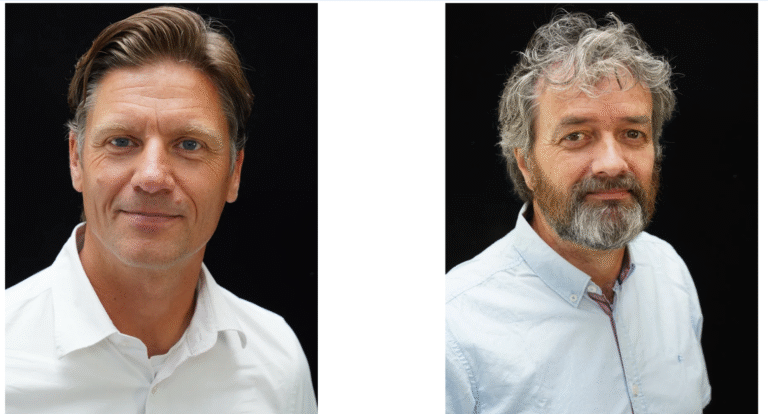
Links Marco de Boer en rechts William Leenders
Van academie naar praktijk
William Leenders deed jarenlang onderzoek naar kanker aan het Radboudumc. Hij raakte gefascineerd door personalized medicine, maar zag ook de beperkingen ervan. “Veel patiënten reageren niet op therapie, en dat heeft alles te maken met de manier van diagnostiek,” vertelt hij. “DNA-analyses die tegenwoordig regelmatig gedaan worden geven informatie over genetische mutaties, maar zeggen niets over de activiteit van genen. RNA vertelt ons juist welke genen aan of uit staan, én levert gelijktijdig informatie over mutaties.”
In 2017 ontwikkelde Leenders een robuuste RNA-test op basis van Next Generation Sequencing. Omdat deze techniek veelbelovend bleek te zijn voor de patiëntenzorg, besloot hij samen met Marco de Boer in 2019 Predica Diagnostics op te richten.
Een krachtige technologie
Marco de Boer, gepromoveerd moleculair bioloog, had al ervaring met het opzetten van biotech bedrijven. Na het verlies van een dierbare aan kanker was de stap naar Predica snel gezet. “William zocht iemand met bedrijfservaring, en ik wilde iets doen dat impact heeft,” zegt hij. Als algemeen directeur houdt hij zich bezig met de zakelijke kant, terwijl Leenders zich richt op de wetenschap.
De technologie van Predica is gebaseerd op RNA-analyse via Next Generation Sequencing. Waar DNA-analyses mutaties opsporen, kijkt RNA naar genactiviteit. “Dat is cruciaal,” legt De Boer uit. “Bijvoorbeeld bij baarmoederhalskanker, dat veroorzaakt wordt door het HPV-virus. Veel vrouwen zijn besmet met HPV, maar slechts een klein deel loopt daadwerkelijk risico. Onze test kan in een uitstrijkje meten welk HPV-virus aanwezig én actief is, en of kankergenen actief zijn. Daarmee kunnen we veel beter voorspellen wie risico loopt.”
Focus op women’s health
Hoewel de technologie breed toepasbaar is – van hersentumoren tot longkanker – kiest Predica bewust voor focus. “We richten ons nu op women’s health,” zegt Leenders. “We kijken bijvoorbeeld ook naar het microbioom bij vrouwen dat een algemene impact heeft op gezondheid, naar endometriose en natuurlijk baarmoederhalskanker. Daar zit een enorme unmet need.”
Die keuze is deels praktisch: uitstrijkjes zijn relatief eenvoudig te verkrijgen als klinisch materiaal. Maar het is ook strategisch. “Tot voor kort werd er weinig ontwikkeld voor vrouwen,” zegt De Boer. “Veel medische innovaties waren gericht op mannen. Nu is er meer aandacht voor women’s health, en wij willen daar een bijdrage aan leveren.”
Baarmoederhalskanker is wereldwijd een van de meest voorkomende vormen van kanker bij vrouwen. “Er is al veel overtuigend bewijs dat baarmoederhalskanker voorkomen kan worden met vaccinatie tegen HPV, maar dat werkt alleen bij meisjes die nog nooit een HPV infectie hebben doorgemaakt. Bovendien, met de huidige lage vaccinatiegraad van 60 procent, blijft screening de komende decennia cruciaal,” aldus Leenders.
De huidige screeningsmethode is niet efficiënt. Het begint met een test op aanwezigheid van HPV in een vaginale zelfafname die een vrouw thuis kan doen, of in een uitstrijkje die door de huisarts wordt genomen. Wanneer HPV aangetoond is, wordt een uitstrijkje onder de microscoop onderzocht (de PAP-test). Wanneer dat onderzoek afwijkende cellen laat zien, volgt een onderzoek door een gynaecoloog. “De onnauwkeurigheid van de PAP-test leidt tot veel onnodige doorverwijzingen,” zegt De Boer. “Onze test kan direct uit het eerste monster bepalen of er sprake is van HPV activiteit én of er wel of niet sprake is van kankerontwikkeling . Dat maakt het proces veel efficiënter.”
De Europese Unie heeft om deze reden recent geadviseerd om de PAP-test af te schaffen. “Dat onderstreept de noodzaak voor betere testen,” zegt Leenders. “Onze technologie valt precies in die categorie.”
Gebruiksvriendelijk, schaalbaar en kosteneffectief
Een belangrijk voordeel van de technologie is de schaalbaarheid. “We kunnen tot 4000 uitstrijkjes tegelijk analyseren,” zegt De Boer. “Dat maakt de test kosteneffectief.” Bovendien heeft Predica eigen software en algoritmes ontwikkeld, waardoor de analyse en rapportage grotendeels geautomatiseerd zijn. “Je hebt geen bioinformatici meer nodig. Dat maakt het toegankelijk voor laboratoria.”
De technologie bevat ook elementen van kunstmatige intelligentie (AI), die helpen bij het interpreteren van de complexe data. “Het klinkt misschien ingewikkeld en duur,” zegt Leenders, “maar we hebben het juist versimpeld en betaalbaar gemaakt.”
Samenwerkingen en internationale interesse
Predica werkt nauw samen met het Radboudumc, waar de technologie is ontwikkeld en gepatenteerd. De patenten staan op naam van het Radboudumc en Predica heeft de wereldwijde exclusieve rechten. “We hebben afspraken gemaakt dat wij die patenten mogen gebruiken om producten te ontwikkelen. En als tegenprestatie betalen wij in de toekomst weer een stukje geld terug op het moment dat wij producten verkopen,” zegt De Boer
“En we hebben een nauwe samenwerking met oncologen en gynaecologen daar. Zij zijn onze early adopters.”
Ook internationaal groeit de interesse. Sequencer fabrikant MGI vond de technologie zo veelbelovend dat ze een apparaat bij Predica hebben geplaatst. “Dat stelt ons in staat om sequencing zelf te doen,” zegt De Boer.
Daarnaast is Predica in gesprek met bedrijven die de technologie willen inlicenseren voor andere toepassingen. “We hebben vorig jaar ons eerste product gelanceerd,” zegt De Boer. “Labs gebruiken het al, en dat wekt vertrouwen. Nu zoeken we partners om verder te groeien.”
Sterk ecosysteem in Nijmegen
De regio Arnhem-Nijmegen biedt een vruchtbare bodem voor innovatie. Predica ontving financiering van onder andere OostNL en groeivouchers via Briskr. “Dat heeft ons echt geholpen om stappen te zetten,” zegt De Boer.
Een technologie met toekomst
Predica Diagnostics staat aan het begin van een veelbelovende reis. Met een innovatieve RNA-technologie, een duidelijke focus op women’s health en een sterke wetenschappelijke basis, heeft het bedrijf alles in huis om de diagnostiek van kanker en andere ziekten te verbeteren. “We weten dat onze technologie werkt,” zegt Leenders. “Nu is het tijd om die impact ook in de kliniek te realiseren.”
Every Movember, the spotlight turns to men’s health, and this year, Medip Analytics used the moment to take a closer look at one of the most common and impactful diseases affecting men: prostate cancer. Despite ongoing advancements, significant improvements in the Dutch diagnostic pathway remain within reach.
Each year, approximately 250,000 men in the Netherlands are screened, and around 15,000 receive a prostate cancer diagnosis. While care quality continues to evolve, the system still faces avoidable challenges: unnecessary biopsies, delayed detection of significant cancers, overtreatment of low-risk disease, and rising healthcare costs.
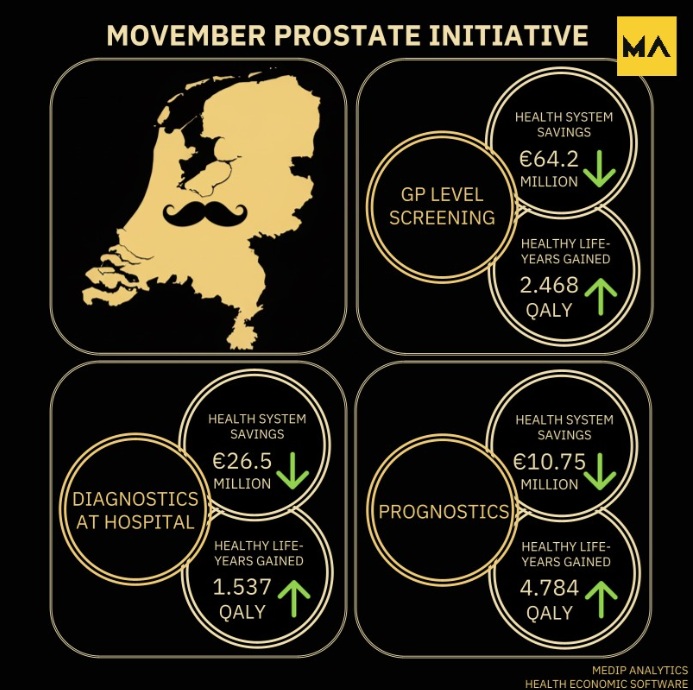
To better understand where gains can be made, Medip Analytics conducted a comprehensive headroom analysis using its proprietary health economic software. The goal: to calculate how much improvement is possible if today’s care pathway operated under optimal conditions.
Three critical points in the pathway
The analysis focused on three key stages of the prostate cancer journey:
GP screening: identifying risk earlier and more accurately in primary care
Hospital diagnostics: improving precision in imaging and biopsy workflows
Prognostics: supporting clinicians to make better-informed treatment decisions
By modelling the current standard of care and comparing it to a “perfect care pathway,” Medip Analytics quantified the potential annual impact if bottlenecks were removed and best practices widely adopted.
A clear impact on outcomes, costs, and patient experience
The resulting infographic illustrates how small changes at each stage can add up to significant national impact. Improvements across the pathway show potential for:
Fewer unnecessary biopsies
More detection of clinically significant cancers
Less overtreatment of low-risk patients
Lower overall healthcare costs
Better long-term outcomes for men living with prostate cancer
These findings not only identify gaps but also show that better care is already within reach.
Three solutions making a difference today
To make the analysis concrete, Medip highlighted three technologies already improving parts of the pathway:
Proclarix by Proteomedix AG: enabling more effective and targeted screening in primary care
QP-Prostate by Quibim: bringing greater accuracy to hospital-based MRI analysis
Genomic Classifier by Prostatype Genomics AB: providing stronger prognostic guidance to tailor treatment
Together, they demonstrate how innovations can reduce unnecessary procedures, detect important cancers earlier, and support clinicians with clearer, data-driven insights.
A clear message this Movember
With this initiative, Medip Analytics underscores a powerful point: we don’t need to wait for future technologies to improve prostate cancer care, the tools to create impact already exist today. Optimizing how they are implemented can unlock substantial clinical and economic benefits across the Dutch healthcare system.
For those interested in the detailed calculations, methodology, or opportunities for collaboration, Medip encourages reaching out to Rijk Faselor the Medip Analytics team. Find here the pdf-file.
Many people fear the moment they or someone close to them starts ‘slipping’. A name that won’t come, a forgotten appointment, small moments of confusion. For millions, these everyday lapses raise a worrying question: is this the beginning? Remind is building a platform to give people clarity much earlier than current systems, and in doing so, lighten the strain on healthcare and families.
Remind originated inside the venture studio of insurance company Nationale Nederlanden, focused on developing startups around the challenges of an ageing population.
One in five people will develop dementia, and every diagnosis affects an entire circle of relatives. Co-founders Job van der Heijden (CTO) and Willem Schüngel (CEO) noticed a growing gap: in the years before someone enters a care facility, people with early signs of dementia often depend heavily on partners and children. “They’re the ones who deal with the day-to-day realities long before there’s a diagnosis”, says Willem.
At the same time, many people worry about their own risk. “People often ask themselves: am I next? And that fear grows when they’ve seen what dementia can do to a loved one. I started digging into this issue, and it simply wouldn’t let go of me”, Willem says.
With Jobs’ experience in medical informatics and digital hospital systems and Willems entrepreneurial skills, they decided to independently build a product that could help people earlier, at home, before symptoms escalate. Nationale Nederlanden remains co-founder and early funder.
Understanding dementia earlier, from home
Within our care system, dementia is often diagnosed fairly late. People can struggle with symptoms for years before reaching a memory clinic. And 30% of referred patients turn out not to have dementia at all — their symptoms stem from things like stress, menopause or depression, adding unnecessary pressure on hospitals.
Remind’s solution
At the same time, technological innovations focus on earlier detection. New cognitive, behavioural and speech-based tests are emerging, measuring one piece of the puzzle. Remind combines multiple validated technologies into one platform and tracks changes over time.
The result is a multimodal user profile based on cognitive questionnaires, memory tests, fine-motor assessments, and short speech recordings, to name a few. By monitoring subtle changes in several domains, Remind aims to detect early signals of dementia or Alzheimer’s disease sooner.
The platform translates test results into personalised recommendations. By identifying individual risk areas, the system can highlight where lifestyle or behavioural changes are most impactful, and track progress over time.
The promise: clarity, prevention and control
Early detection has many benefits. For healthcare in general, it reduces pressure by improving the quality of referrals. When mild symptoms can be assessed at home, only people with clear indications need clinical testing.
For patients, earlier insight means earlier action. “If you start lifestyle interventions early, the risk of developing dementia can be reduced significantly. Up to 45 percent, according to research. Furthermore, people want to stay in control. They want to understand what’s happening so they can decide for themselves how they want to organise the later phase of their life.”
Science, validation and partnerships
Remind uses validated components developed by Dutch academic institutions. To further strengthen the scientific basis, Remind will run a pilot with Hersenonderzoek.nl, part of the Alzheimer Centre at Amsterdam UMC. Participants already enrolled in research programmes will be onboarded onto the platform, helping Remind gather the volume and diversity of data needed for future development.
Validation is the company’s biggest milestone: first proving the accuracy of the model, then pursuing the licences required to support clinical diagnosis. That process typically takes several years. Until then, Remind focuses on early signalling rather than medical confirmation.
A model designed to scale responsibly
To build evidence, Remind will first launch through a subscription model. This excludes some groups initially, but it is the only feasible route to collect real-world data at scale. The aim is clear: within two to three years, start formal conversations with insurers about reimbursement for all patients.
Alongside the consumer launch, Remind is preparing a B2B strategy for memory clinics, pharmaceutical trials and healthcare providers. International expansion will follow, requiring retraining algorithms to capture contextual nuances.
The value of BANN
Nijmegen offers strong ties to academic partners and a concentration of organisations working on digital health. For an innovation that sits at the intersection of data science, clinical research and user-centred health tech, the regional ecosystem is a natural fit.
Remind is actively involved in the Nijmegen ecosystem and has already benefited from participating in the BANN programme. “The feedback was genuinely valuable. It helped us sharpen our story and look at it from a different angle.” The event also provided new contacts and introductions, some of which will play a role in the next phase of development.
What comes next
January’s launch marks a major turning point: the first real-world users, the first dataset and the first opportunity to prove the model’s value. From there, the roadmap moves through several phases: validating accuracy, expanding the user base, running the pilot with Hersenonderzoek.nl, iterating the product and then scaling towards B2B partnerships and insurance integration.
Ultimately, Remind wants to empower people long before dementia takes over their lives. If the team succeeds in delivering the evidence behind their promise, they could reshape how society approaches one of its most pressing age-related challenges.
Ieder jaar presenteert het kabinet het Belastingplan op Prinsjesdag. Lang niet alle in het Belastingplan gepresenteerde plannen halen de kranten, maar dat betekent niet dat de wijzigingen geen gevolgen kunnen hebben voor de belastingheffing bij uw organisatie. Daarom informeren wij u middels onze eindejaarstips over de wijzigingen in het Belastingplan en van welke besparende tips u nog op de hoogte moet zijn.
Zowel zakelijk als privé in één digitaal overzicht. Zo bent u er zeker van dat de jaarwisseling ook voor u een financieel positieve afdronk heeft. U kunt de tips per categorie aanklikken die voor u relevant zijn. Ga hier naar alle fiscale eindejaarstips.
Hulp nodig?
Kunt u advies of hulp gebruiken bij één van de tips die onze supporting partner BDO op deze pagina heeft gedeeld? In een persoonlijk gesprek denken zij graag met u mee en bespreken zij bovendien waar u aan het einde van het jaar nog meer op kunt letten. U kunt met Bernard de Vree contact opnemen via mail.