How much potential is still untapped in prostate cancer care? Medip Analytics reveals new insights this Movember

Every Movember, the spotlight turns to men’s health, and this year, Medip Analytics used the moment to take a closer look at one of the most common and impactful diseases affecting men: prostate cancer. Despite ongoing advancements, significant improvements in the Dutch diagnostic pathway remain within reach.
Each year, approximately 250,000 men in the Netherlands are screened, and around 15,000 receive a prostate cancer diagnosis. While care quality continues to evolve, the system still faces avoidable challenges: unnecessary biopsies, delayed detection of significant cancers, overtreatment of low-risk disease, and rising healthcare costs.
To better understand where gains can be made, Medip Analytics conducted a comprehensive headroom analysis using its proprietary health economic software. The goal: to calculate how much improvement is possible if today’s care pathway operated under optimal conditions.
Three critical points in the pathway
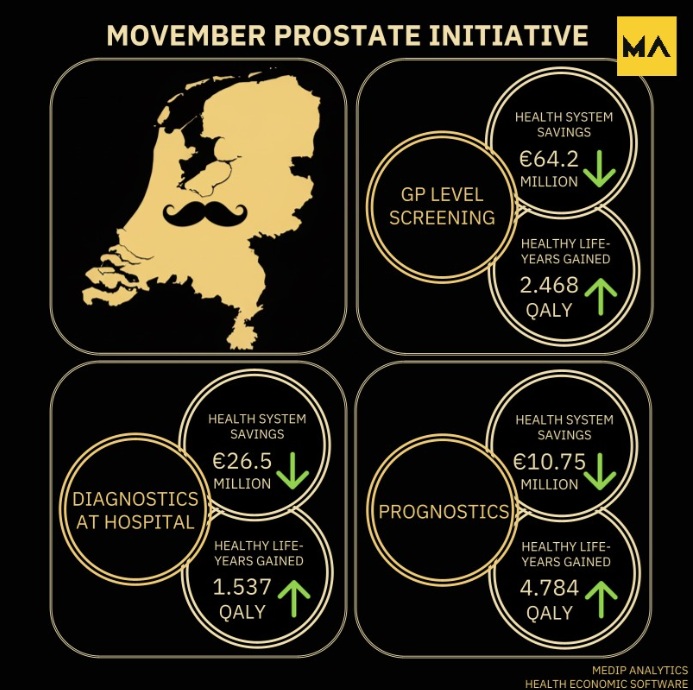
The analysis focused on three key stages of the prostate cancer journey:
- GP screening: identifying risk earlier and more accurately in primary care
- Hospital diagnostics: improving precision in imaging and biopsy workflows
- Prognostics: supporting clinicians to make better-informed treatment decisions
By modelling the current standard of care and comparing it to a “perfect care pathway,” Medip Analytics quantified the potential annual impact if bottlenecks were removed and best practices widely adopted.
A clear impact on outcomes, costs, and patient experience
The resulting infographic illustrates how small changes at each stage can add up to significant national impact. Improvements across the pathway show potential for:
- Fewer unnecessary biopsies
- More detection of clinically significant cancers
- Less overtreatment of low-risk patients
- Lower overall healthcare costs
- Better long-term outcomes for men living with prostate cancer
These findings not only identify gaps but also show that better care is already within reach.
Three solutions making a difference today
To make the analysis concrete, Medip highlighted three technologies already improving parts of the pathway:
- Proclarix by Proteomedix AG: enabling more effective and targeted screening in primary care
- QP-Prostate by Quibim: bringing greater accuracy to hospital-based MRI analysis
- Genomic Classifier by Prostatype Genomics AB: providing stronger prognostic guidance to tailor treatment
Together, they demonstrate how innovations can reduce unnecessary procedures, detect important cancers earlier, and support clinicians with clearer, data-driven insights.
A clear message this Movember
With this initiative, Medip Analytics underscores a powerful point: we don’t need to wait for future technologies to improve prostate cancer care, the tools to create impact already exist today. Optimizing how they are implemented can unlock substantial clinical and economic benefits across the Dutch healthcare system.
For those interested in the detailed calculations, methodology, or opportunities for collaboration, Medip encourages reaching out to Rijk Fasel or the Medip Analytics team. Find here the pdf-file.