In manufacturing, quality is essential and projects need to be done right the first time. The engineering component in such projects is both complex and time-consuming. According to the founders of EnginX, there are more efficient ways of working. CEO Saskia Eijkelhof talks about their innovative software to tackle technical design struggles.

No matter how complex an engineering project, it always starts with a technical drawing. It is also where the challenges arise that EnginX solves. Saskia tells: “The first technical drawing is incredibly complex. It has to be absolutely right in terms of physics and mathematics. Because obviously, you don’t want to develop and deliver a hydrogen system and then discover it doesn’t work, or worse: it explodes. It’s a process with many mandatory checks and iterations and it’s very time-consuming. It is necessary to be meticulous, but we are sure we can improve the process.”

Design, populate and simulate

EnginX’s software allows engineers to make technical designs that are responsive. And instead of solely using industry icons and then searching for the right part, you can create drawings and populate them with real components. “It allows you to simulate and calculate directly from the drawing, making finding suitable components much quicker and easier. There is no search engine for a pump with a specific diameter and flow rate. So until now, engineers have had to call manufacturers and suppliers for details. Or they had to flip through paper catalogues and compare and convert metrics and compare data —an incredibly tedious and time-consuming process.”

Saskia first heard about EnginX through Mercator Launch. “I was immediately drawn to the technical challenge they were wanting to solve. I have never engineered myself, but having worked in manufacturing environments, I recognize the struggles. Especially when customers come up with additional requirements during a project, I could see engineers implode as they knew they had to recalculate every component in the whole system.”

In 2016, EnginX was established by three founders from different engineering backgrounds: aviation, the oil and gas industry and astrophysics. They all had one thing in common: they wanted to improve and modernize the outdated and time-consuming way of working in engineering. The first step was to update the design process itself.

“This resulted in a powerful product and the next step was to write a conclusive business plan”, explains Saskia. “Thomas Bronzwaer participated in two Mercator Launch IMPROVE programs to get the necessary support. And this is where we got to know each other. I joined EnginX not long after. After two years, the board asked me if I wanted to take over as CEO, allowing Thomas to focus fully on the technical side as CTO.”

Steps in growth

The product worked well, so the next step was figuring out how to market it. It takes more than showing off your self-written code to convince potential buyers. However, when pitching, EnginX noticed a growing interest in the product. “When I became CEO, I immediately started looking for financing instruments, such as the Startup Fonds Gelderland, OostNL and the Business Angels Network Nijmegen. We were able to join through Briskr. Having money at hand makes life a lot easier! We can start planning for the future.”

Twelve people now work at EnginX. “I wouldn’t call us a scale-up just yet, but we are getting there! Our growth has taken off. We are happy we can count on support from Mercator Launch, OostNL and Briskr for their network, knowledge and partners. The ecosystem these organizations have built up in Nijmegen and beyond is amazing.”

A household name

Having taken the first steps, EnginX can now look forward. “We want to be a household name for engineers. In fact, with our software, we could do even more to tackle early-phase engineering problems. From energy efficiency and 3D geometry to maintenance and project planning; we want to contribute to it all.”

The company focuses on storming the Dutch market. “We joined the Verenigde Maakindustrie Oost-Nederland (VMO), with 200 affiliated manufacturers in the east of the Netherlands and the GMV with affiliated manufacturers in the food production industry to both understand our market and be able to converse with potential users. And why look abroad for customers when there is still so much to solve in the Netherlands?” According to Saskia.

MindAffect, a Netherlands-based healthtech startup, has raised €1.1mn to bring its hearing diagnostics technology to market.

A spinout from Radboud University, MindAffect has developed a patented brain computer interface (BCI) technology, which enables diagnosis of hearing impairments using brain signals.

MindAffect aims to provide a more equitable testing solution that specifically caters for hard-to-test patients, such as children, the elderly, and people with disabilities.

Current methods, such as pure-tone or speech testing, depend on the constant responses of patients. But this can be challenging or ineffective for individuals who are unable to communicate due to age or disability — resulting in underdiagnosis.

Unaddressed hearing impairments can have serious consequences for both patients and the society, from mental health issues to high healthcare costs

“Hearing loss profoundly impacts every facet of life,” MindAffect’s CEO Jennifer Goodall said in a statement.

“For children, this means risks of poor educational and social development; for the elderly, increased isolation and a greater risk of early dementia; and the disabled, fewer opportunities for social inclusion.”

A new hearing diagnostics system

To tackle this issue, MindAffect has combined neuroscience, BCI technology, and AI to develop Aurora, a response-free hearing diagnostics system, which relies on brain stimuli and signals.

Aurora uses a headband that patients wear while listening to soft chirps and watching a silent video for less than 10 minutes. The system reads the brain signals and combines the information with air conduction and bone conduction audiometric threshold tests to make the diagnosis.

MindAffect expects to launch Aurora next year. The company is also working on vision diagnostics for children as well as a solution to monitor work-related stress in demanding visual or auditory environments.

Existing and new investors backed the funding round, including the NLC Health Impact Fund, Barco Limpo, and Wasteland Investments.

Source: Dutch startup to test hearing via brain-computer interface (thenextweb.com)

The techniques used in electrophysiology are old school, especially when looking into the animal brain. The new technique uses tiny electrodes, which are a quart of the width of a human hair. Those electrodes are an order of magnitude better than the old ways, but also very, very expensive. And prone to breaking. 3Dneuro fixes that problem with their new hardware. We discuss this with CTO Tim Schröder.

Doing research with needle-thin electrodes that are hard to find and also very expensive. “Quite stressful!”, says Tim. “Something had to change. The old technique is like taking pictures with your 1990s Nokia: it works, and it’s impossible to break, but the pictures are bad. The new technique is like using the latest iPhone instead to take a photograph. Beautiful. But if you drop it, there is a risk that your brand new €1000 device breaks, even after taking just one picture. Our brain implant is like a military-grade phone case: it protects the electrodes. That way, we make brain experiments cheaper, easier and more efficient.”

Between science and production   

As a company, 3Dneuro strikes a balance between scientific research and production. The three founders, Abdel Nemri, Martha Havenith and Tim Schröder, are close to the research field. “We are a mix of hardware production and R&D. When we started 3Dneuro in 2017, we were all still working full-time at our universities. We did this on purpose and built the company up on the side. That way, we could make a name for ourselves while still maintaining our connection with the academic world. The switch to working full time for 3Dneuro was quite organic, in the end!”

The company started as a spin-off from the Radboud University, with the help of incubator Mercator Launch. “Getting up and running was difficult, but we knew it would be. Animal experimenting is a difficult field after all, both politically and socially. In a perfect world, they would not be necessary. But, at this point in time, these experiments are still absolutely necessary to advance science and will be for some decades. Therefore, our aim is to make them as efficient as possible. With the best methods, fewer animals are needed to get the results we need.”

3Dneuro works for the academic market. A second challenge which Tim saw coming. “It is a small and slow market. You have to show laboratories exactly why you’re the best solution before they want to do business with you because switching your procedures can cost thousands of euros. That’s why starting out part-time was a good idea: we were able to slowly build trust within the market.”

The 5-year mark

A third challenge came more unexpected: the decrease in funding. “As our company approached the 5-year mark, we saw that funding for start-ups stopped. With the right funding, we were able to scale things up. But without it, we were forced to become more marketable. Our approach of growing slowly wasn’t viable anymore.”

However, 3Dneuro was still able to make the transition. “We’re slowly becoming an established name. The brain implants we make are sold to 75 labs worldwide. From US universities to Nobel prize winners. And finally, we are seeing returning customers because they are working properly with our implants. We are also about to launch our second product, which is not an implant. It enables VR research on animals. Until now it was impossible to do VR research on rats. But together with Nelson Totah, a researcher in Helsinki, we made it work.”

Part of this change came through Mercator Launch. “I heard about Briskr through the incubator. I saw that Briskr was hosting seminars, and I started attending them. From business valuation to pitching and everything in between: I learned a lot! It is nice to be exposed to other companies and the ecosystem in Nijmegen. The Noviotech Campus is a good place for us to be, and it never hurts to broaden your horizons. For me personally, the BANN was great. As CTO, I don’t pitch that often. This was my chance to pitch 3Dneuro outside of the purely scientific world.”

Goals and dreams

After Covid Tim no longer answers the ‘where do you see yourself in 5 years’ question, but 3Dneuro’s goals are clear. “We want to establish our brain implants further and make it easier for researchers to carry out their experiments more easily. All this is driven by a bigger dream: we simply don’t know enough about the brain to solve all our issues yet. We want to know more, essentially everything, about the brain! By studying the brain better, you can unlock that knowledge. Our implants help scientists study the brain better, faster and cheaper.”

Met een knapperig haardvuur op de achtergrond, zijn we in de prachtige Ridderzaal van Slot Doddendael gestart met het plenaire programma. Sjoerd Klabbers van BANN partner BDO leidde ons vervolgens soepel door de presentaties en pitch video’s.

De spreker was Ton Rosendaal van Whizzdom.Ton is één van onze leden en een ervaren angel investor. Hij vertelde over zijn praktijkervaringen met RVO’s Seed Business Angel regeling. Aan de hand van zijn eigen investeringen gaf hij ook toelichting over de voor-en nadelen van deze “Verdubbelaar op je eigen investeringskapitaal”. Meer informatie vind je via deze link. En klik hier voor de slide deck van Ton.

Vervolgens konden we kijken naar 4 nieuwe pitch video’s en volgden de rondetafel sessie’s waarbij angels en partners vragen konden stellen en pitchers (+ team) meer informatie konden geven over hun propositie. We sloten af met wederom een heerlijk culinair walking dinner met 5 gangen.

Pitchende startups
De volgende ondernemers hebben gepitcht tijdens deze bijeenkomst:

  • Bas-Jan Hoogenberg, Bondus
  • Pieter van Weijen, inn4cure
  • Peter Deen, Streasure4Health
  • Desiree van Maasakker, Let’s Zoip

When you hear the words ‘cocktail party’, all sorts of positive associations will probably start firing up in your brain. Unfortunately, not all of us feel this way. For people who suffer from hearing difficulties, the so-called Cocktail Party Problem, surrounding sounds blend into one big blur, making it very difficult to distinguish each individual sound and its source from other sounds. By looking at the way bees move their ears and perceive sound, startup BeephoniX may just have found a solution, says CEO Klaas-Jan Kakebeeke.

The bee’s knees

The inspiration came a couple of years ago when Martijn Agterberg, associate professor at Radboud University and audiologist, visited a beekeeper’s lecture. “There, he learnt that bees use their antennas as moveable ears, which enables them to trace the source of a sound”, explains Klaas-Jan. “Based on this mechanism, Martijn and technical engineer Patrick Wijnings developed a dynamic microphone that rotates and can determine the source of a sound.”

The Cocktail Party Problem can turn into a harmful problem. Despite all efforts from the industry,  current hearing devices amplify all sounds and are not yet solving the problem. Because of this, people who wear them tend to avoid busy and noisy environments and larger groups, because they are unable to hear what others are saying. Not only does this increase the amount of stress put on the ear, but it also leads to uncomfortable feelings, and potentially, social isolation. This is a major problem, and an innovation that can solve this problem is important”, according to Klaas-Jan.

BeephoniX’s innovation may prove to be interesting for people who experience the Cocktail Party Problem. “According to the World Health Organisation, by 2050, one in four people will suffer from hearing problems to some extent. By placing our microphone into hearing aids, conversations will be easier in noisy situations.”

So, how does the innovation work? “Our technology consists of a moving microphone. When a speaker is talking from the direction of the movement, the microphone causes a Doppler effect. When a speaker is talking from the other direction, no Doppler effect occurs. This means that we can localise the position of the sound source by measuring the strength of the Doppler effects.”

Taking off

Klaas-Jan and Patrick joined the BeephoniX team a little over a year ago. They participated in the NWO Venture Challenge, where their idea earned them a respectable second place. They also received a take-off 2 loan from NWO of 250.000 euros, and additional funding of 190.000 euros. This paved the way for other collaborations.

BeephoniX’s prototype, the Beepod, has already gathered much interest from organisations such as the Ministry of Defence, which has offered BeephoniX a grant and wants to use the technology to detect drones. “We’re also talking to Holland Health and an Austrian company, who were blown away by our prototype. Currently, we’re working on version 2.0.”

Klaas-Jan: “Of course, our collaboration with Briskr has been great. When you are a startup in the world of health and high tech, investors can have trouble seeing the long-term goal. You often need a lot of investments. Briskr introduced us to promising business angels and continues to support us with services such as workshops and business valuation.”

Flying high

BeephoniX’s goal is clear, says Klaas-Jan. “Solving the Cocktail Party Problem, of course! If we succeed, we have realised something beautiful. We’ve gathered the first critical funding, and now we need to make sure we keep up the pace and realise our ambitious goal.”

“It would be fantastic if our microphone ends up in hearing devices. We’re very excited to see where the journey takes us.”

Wilt u duurzaam innoveren, uw innovatie testen of demonstreren?
Dan is nu een goed moment om de subsidiemogelijkheden van EFRO Oost te ontdekken en te benutten! Het Europese subsidieprogramma EFRO Oost 2021-2027 stelt ruim 40 miljoen euro beschikbaar voor innovatieve en samenwerkende ondernemers in Overijssel en Gelderland. 

Twee mogelijkheden
Het beschikbare budget is verdeeld over twee subsidieregelingen die mkb-bedrijven stimuleren tot productontwikkeling, digitalisering, duurzaamheid en/of het testen en/of het demonstreren van innovaties. 

  1. Innovatieprojecten 
    Deze regeling is voor marktgerichte innovaties binnen TRL-niveau 4-8. Ondernemers met een slim en duurzaam idee die willen samenwerken met (andere) mkb-ondernemers, grootbedrijven en/of kennisinstellingen kunnen subsidie aanvragen. Voor deze openstelling is voor Gelderland en Overijssel samen een totaalbedrag van bijna € 34 miljoen beschikbaar. U kunt uw aanvraag indienen vanaf 1 februari 2024 tot en met 31 januari 2025 (zolang er budget beschikbaar is).
    Lees hier alle informatie over de regeling Innovatieprojecten.

  2. Test- en demonstratiefaciliteiten
    Deze regeling is voor het demonstreren en testen van nieuwe toepassingen binnen TRL-niveau 6-8. Denk aan: innovaties die op lab-schaal zijn getest en gevalideerd en die u in de praktijk wilt demonstreren, activiteiten in proeftuinen met testmogelijkheden en living labs waarbij een prototype wordt gedemonstreerd. Doel is te zorgen voor een versnelde marktintroductie van producten of diensten. Samenwerkingsverbanden van mkb-ondernemingen, of van mkb-ondernemingen met grootbedrijven en/of kennisinstellingen die willen bijdragen aan een slimme en duurzame economische ontwikkeling van de regio kunnen een aanvraag indienen. Voor deze openstelling is voor Gelderland en Overijssel samen een totaalbedrag van €16,5 miljoen beschikbaar. U kunt uw aanvraag indienen vanaf 1 maart 2024 tot en met 31 januari 2025 (zolang er budget beschikbaar is).
    Lees hier alle informatie over de regeling Test- en Demonstratieprojecten

Goed nieuws
Om meer mkb’ers in aanmerking te laten komen voor  EFRO-subsidie is de ondergrens van de aanvragen verlaagd naar € 250.000. Daarnaast wordt de bovengrens van de subsidie verhoogd naar € 2.000.000. Het subsidiepercentage voor kennisinstellingen is verhoogd naar maximaal 50 procent. Daarmee is het gelijk aan dat van mkb-ondernemingen. 

Procedure
Voor de regelingen die worden opengesteld, kunnen het hele jaar aanvragen ingediend worden. Een regeling sluit echter op het moment dat het beschikbare budget op is. De subsidieaanvragen worden op volgorde van binnenkomst beoordeeld (first come first serve). Een projectvoorstel wordt beoordeeld door de deskundigencommissie om in aanmerking te komen voor subsidie.

Ondersteuning 
EFRO Oost staat klaar om met u te kijken naar de mogelijkheden en kansen van uw projectidee. Heeft u een idee voor een project en wilt u weten of het past binnen de subsidiemogelijkheden? Dien dan uw projectidee in of neem hier contact op met EFRO Oost.

Learn more about the the most innovative work locations in the East of the Netherlands, in our updated Science & Innovation Parks and Campuses brochure! We highlight 9 campuses and innovation parks focussing on agri-food, life sciences & health, high-tech and smart energy.

Download the brochure here. The Netherlands is among the top countries for research and development, with a unique mix of innovative businesses working alongside renowned knowledge institutes. In part these activities take place at central locations, stimulating collaboration and inviting talent.

Do you have an innovative idea, an entrepreneurial mindset and do you want to start your own business? Pitch your idea to one of our business coaches and together we will decide which track best suits your needs.

Discovery Track

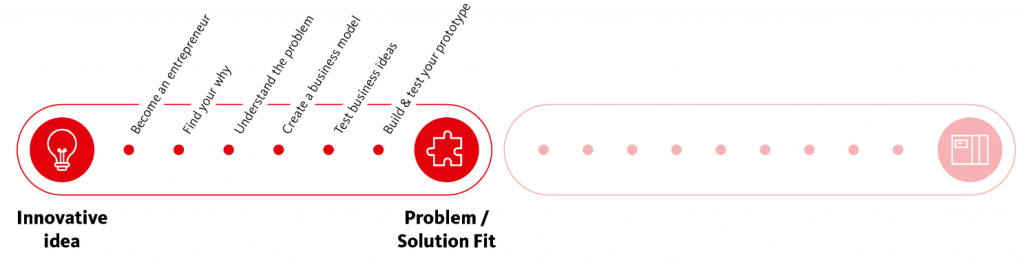
Our Discovery Track is a 6-step programme that supports future entrepreneurs, like you, in the important first stages of starting your own business. The programme is based on the Lean Startup method and guides you through the most vital steps of discovering your customer segment, value proposition, business model and first prototype. You will get all the necessary strategies, tools and support to make sure that you achieve your problem/solution fit. Do you have that million dollar idea? Don’t miss our next edition.

Sign up here (30 days left from now)

Venture Track

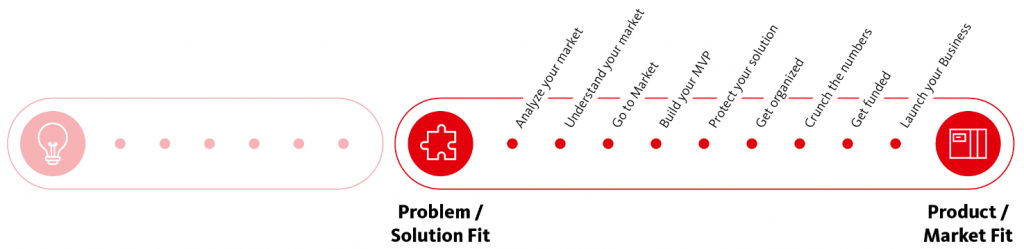
Our Venture Track is a 6-step programme that supports future entrepreneurs like you in really starting your own business. The programme is based on the Lean Startup method and guides you through the most vital steps of creating competitive advantage, get your first customer and set up your financials & funding strategy. You will get all the necessary strategies, tools and support to make sure that you achieve your product/market fit. Do you have that validated innovative idea? Don’t miss our next edition.

Sign up here (23 days left from now)

Advance Track

Our Advance Track is a custom made programme that supports entrepreneurs after the Venture Track (or similar programme of startup phase). The Advance Track is for startups which have a support request. Together with a business coach, the startup will formulate a clear goal to be achieved. Based on the goal, a custom made programme will be made.

Sign up here

Are you a Company, Start-up or Public Administration and in need of high performance compute power?

The purpose of this Call of EuroCC Netherlands is to offer access to High-Performance Computing, Machine Learning (or general Artificial Intelligence), and Data Analytics resources (consultancy and infrastructure) to commercial partners (SMEs or corporates).

Deadline: the open call applications will close on Dec. 31, 2023

Who is eligible to apply?

  • Industry SMEs;
  • Corporates;
  • Entrepreneurs;

Located in the Netherlands or other EU Member States or a country associated with Horizon 2020.

The Call for Proposals is continuously open, with a reviewing period of maximum two (2) weeks and immediate access to resources upon successful evaluation. The allocations are granted for one (1) year with the option for projects to apply for a continuation.

This continuation shall be duly justified, limited to a maximum of one (1) additional year, and will depend on an assessment of the ongoing awarded project.

Applicants can only have one Regular Access awarded at any given time.

The computer system provided for the Regular Access call by EuroCC Netherlands is Snellius, hosted by SURF in Amsterdam.

This Regular Access mode offers three distinctive application tracks:

  • Technical Consultancy
  • Access to HPC infrastructure
  • Both Technical Consultancy + Access to HPC Infrastructure

You can apply here.

Shipping companies all want to become more sustainable, but the question is: how? Dirk Degroote of the Nijmegen-based company Cognauship inspires captains to reduce their emissions and costs by mapping out the fuel consumption of ships. “Using energy more sparingly is the only real lifeline we have left to reach the short term climate targets.”

The demand from the market was clear: tugs want to sail more sustainably and more cost effective. But they often struggle on how to do it. In his previous job, Dirk noticed the demand, but couldn’t offer an easily applicable solution. So, he decided to set sail for new horizons. Together with Noud Seegers, he founded the company Cognauship. “My work comprised of many meetings, away from home, long days and regularly travelling. I wanted to get my hands dirty again, and at the same time, spend time with my family.”

And that is exactly what he got, albeit in a different way than he anticipated. “In February 2020, we officially started working at the Noviotech Campus. That lasted for about a month, and then we went into lockdown. When everything came to a halt, my thought processes continued. Of course, it wasn’t what I had in mind, but it gave me the time and space to spend time with my children without responsibilities to an employer. It also allowed me to think long and hard about how to realize the solution I had in mind. All in all, it was exactly what I needed.”

Sailing sustainably

All the thinking led to a unique Internet of Things (IoT) solution, based on monitoring and thoroughly analyzing the movements and exhaust sounds of the ships’ engines, resulting in the identification of potential savings. It sounds simple, but behind the scenes there are a lot of steps to be taken, as it is a long way from sensor data to insights. “Think of data like Lego blocks. When the data comes from the ship, the blocks are scattered all over the place. I use specially developed algorithms for ships to sort them by size and color and then use these blocks to build a house that fits the customer’s needs, which is easy to understand and provides actionable insights. They just see the house, but it took a lot of steps to get there.” We distinguish ourselves by covering this complete path, where most of the competition just offer the raw data and the platform. Let’s say they provide the box of Lego, whether sorted or unsorted, but the customers have to figure out themselves how to build the house. And they lack the personnel and experience to do that.

“It’s no longer about a lack of desire to become more sustainable. Companies often just don’t know how to go about it or cannot figure out a solid business case. We don’t do it for them, but we empower them to become more sustainable and determine the business case, so they can move on. For most ships, it’s not even a major intervention. A few small changes can improve operational efficiency with fuel consumption savings of 10 to 30%. This often involves sailing at lower speeds or adopting different sailing techniques, but also logistic integration and optimization. A few years ago we had this campaign for more sustainable driving in The Netherlands; Het Nieuwe Rijden, which can be seen as a similar solution. But we focus on water.”

Important connections

Dirk was already quite knowledgeable in his field, but starting a business is a different ball game. “In the early stages, I benefited from Briskr’s help in finding other entrepreneurs and experts to exchange ideas with. A critical, outside view can help so much. It’s a reality check: is what we’re doing really relevant? When the answer is ‘yes’, it boosts your confidence to keep on going.”

Dirk is well-known in the towage industry, so his first assignment was with an important player. “We were able to test our prototype at the Port of Antwerp-Bruges. And when that went well, other companies were inspired, too. The Municipality of Nijmegen also made enquiries  about our services to get a better understanding of emissions of ships passing The Waal in Nijmegen and wanting to boost a Nijmegen-based company.”

The municipality’s investment turned out to be worth its weight in gold, as many other companies followed suit. “The events of Briskr and Oost NL and our offices at Noviotech Campus contributed to success as well. This is where we can build our network.”

A sustainable future

“We are quite the odd one out at the Noviotech Campus. Before we arrived, there were no companies representing the maritime industry, even though the industry is quite present in Nijmegen. We started with tugs and now, due to market demand, we also help inland vessels. In our backyard, The Waal, some 300 ships pass by every day, making our work highly relevant here.”

As far as Dirk is concerned, his job is not meant to be relevant forever. “My dream is that everyone in the barging and towing industry becomes aware of how to sail sustainably and act on it by 2030. Preferably with our help, because that would mean we can make impact. If everyone chips in, the climate goals for our sector will be within reach. And that is the goal right now.”