There is more to intellectual property (IP) than meets the eye. Overlooking the hidden parts can put your IP at risk. In biotech, investors are keen to see a robust IP strategy. Patented technology justifies the substantial investments needed to bring new medicines through the regulatory pipeline. An IP strategy also signals your professionalism as an entrepreneur. Taking IP seriously from the start gives you a big advantage.

The helpful employee

Let’s have a look at four examples to show what could go wrong. The first concerns a fictional biotech firm with 40 employees and an open culture built on trust. A client calls the receptionist and asks for the technical drawings of one of the company’s products. However, these drawings are a trade secret. There is no policy in place. The receptionist has access to the drawings and, wanting to be helpful, shares them without requesting a signed non-disclosure agreement (NDA). The client uses the drawings to develop their own version of the product and markets it aggressively. The result? In court, the company faces an uphill battle and may not be able to prove it treated the drawings as a trade secret at all.


When collaboration goes sour

The second example concerns an early-stage start-up that aims to collaborate with a contract research organization (CRO). They have clear agreements in place on foreground IP (the IP that results from the collaboration). All other details are covered by the CRO’s standard collaboration contract. The start-up brings forward many new ideas and suggestions during the collaboration. However, none of these are in writing. At one of their meetings, the CRO informs the start-up that it will file for a patent. The start-up claims that the patent is inspired by their ideas and suggestions. According to the CRO, it further developed the ideas that were brought into the collaboration. As far as the CRO is concerned, the invention is its own. Without written evidence of the start-up’s contributions, the CRO’s position is difficult to challenge. The start-up has lost any claim to inventorship, as well as any share of what may become a valuable patent.


Freedom to operate

In the third example, a biotech company has multiple lines of research and expects to enter the market soon with a new innovation. The company has already announced its new product and the techniques used in production at two high-profile conferences. Shortly afterwards, a letter arrives from a competitor’s lawyer: the new product infringes on a patent application filed by the competitor. The company is forced to postpone the product release until it can negotiate a licence fee with the competitor – assuming the competitor is willing to grant one. By announcing the product and technology publicly, the company alerted a rival who might otherwise not have noticed the overlap. The underlying failure is that the company thought of a freedom-to-operate analysis before investing in the launch.


Going public and the novelty requirement

In the final example, a university spin-off developed a novel medical product. There is a lot of interest in the start-up, prompting it to give interviews and product presentations. The company is explicitly asked to demonstrate its new product, so the audience can appreciate its innovative qualities. At the same time, the company is looking for investors to help bring the product to the market. As IP is a key concern for potential investors, the company wants to file a patent. One of the core requirements for a patent is novelty. But the company already disclosed its product publicly. Now it is wrestling with the novelty requirement: only parts of the invention that were not shown, if any, can still form the basis of a patent filing. The result is a narrower patent at best, no patent at all at worst. For a company built on investor confidence, that is a serious problem: weak IP weakens the pitch, and no IP can end the conversation entirely.

Take IP seriously

The above examples share a common thread: overlooking IP during product development can be costly. Seemingly small omissions like an undocumented conversation or a presentation given too soon can lead to loss of IP, or lost investors. None of these failures are difficult to prevent. It starts with taking IP seriously from day one.

The Netherlands Patent Office is happy to help you. They offer free 1-on-1 consult with a patent advisor: a useful starting point for building an IP strategy.

About the Netherlands Patent Office

The Netherlands Patent Office helps entrepreneurs who want to protect their innovation, find collaboration partners, or secure funding. Whether you are a start-up, scale-up or SME, our support is confidential, independent and free of charge. From walk-in advice sessions at tech hubs to tailored patent search advice: our advisors work across the country to support you.
Bringing an innovative medical device to market is about much more than developing great technology. Understanding the regulatory landscape early on can save valuable time, reduce risks and help you make better strategic decisions throughout your product development journey.

In this practical workshop, regulatory experts from Qserve will guide you through the key differences and similarities between the European and US regulatory pathways for medical devices. Through practical examples, you’ll gain insight into how your product is classified, what evidence is required and how to plan your route to market.

During the second part of the workshop, participants will split into two smaller groups, allowing for more in-depth discussions tailored to their specific technology. Depending on the participating startups, the sessions will focus on either software and AI-based medical devices or non-active patient-contacting and higher-risk medical devices.

Whether you are still validating your idea or preparing for market entry, this workshop will help you better understand the regulatory and clinical considerations that can influence your development strategy.

What will you learn?

  • The different market access routes for medical devices in the EU and the US
  • How to determine whether your product qualifies as a medical device
  • Medical device classification in both regulatory systems
  • What clinical and technical evidence is required
  • How to estimate regulatory timelines, costs and development planning

Speakers

Robert Paassen, Team Manager Regulatory Medical Devices & Senior Consultant | Qserve

Robert has extensive experience in regulatory affairs for medical devices and supports innovative companies in developing efficient regulatory strategies for both European and international markets. During this workshop, he will explain the regulatory fundamentals and help startups understand the key decisions they need to make early in product development.

Additional specialist sessions

To ensure participants receive the most relevant insights, a second Qserve expert will join the workshop based on the technologies represented by the participating startups. Depending on the biggest ask it will be either Coenraad or Bianca:

Coenraad Davidsdochter, Team Manager Regulatory Medical Devices & Senior Consultant

Coenraad specializes in software, AI-based and active medical devices and supports companies in navigating the regulatory requirements for these rapidly evolving technologies.

Bianca Lutters, Director Knowledge Management, Head of Clinical Affairs & Principal Consultant.

Bianca specializes in clinical strategy, implantable and higher-risk medical devices, combining extensive regulatory expertise with deep knowledge of clinical evaluation and evidence generation.

Location
Meet&Greet, Noviotech Campus Nijmegen.

Good to know
The workshop is facilitated in English and is free of charge.

Participation in the workshop is free for everyone, including drinks and bites. However, for noshow and cancellations within 24 hours prior to the event, we will charge a fee of 15 euros (excluding VAT) to cover incurred expenses. By signing up, you agree to this term.

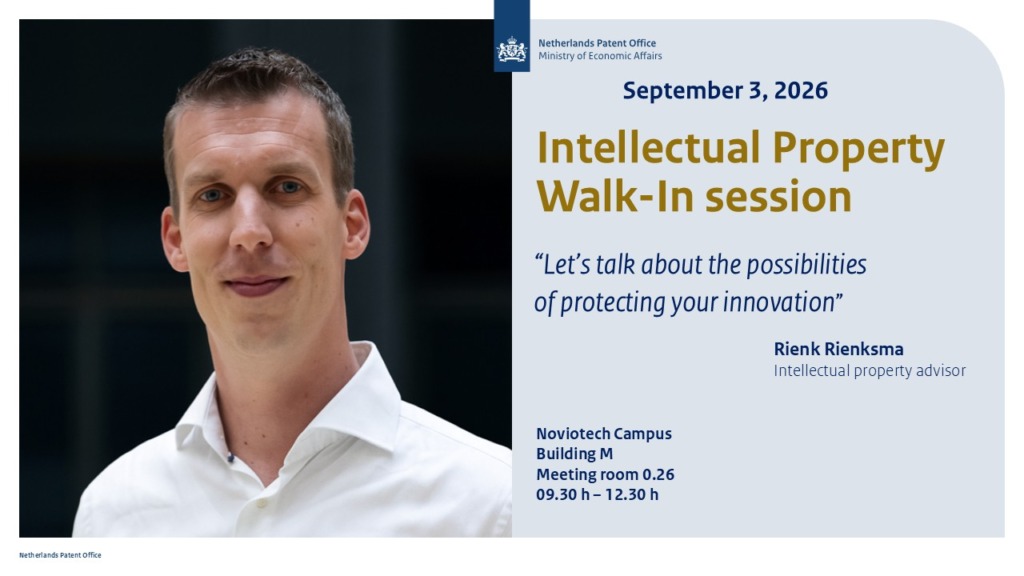
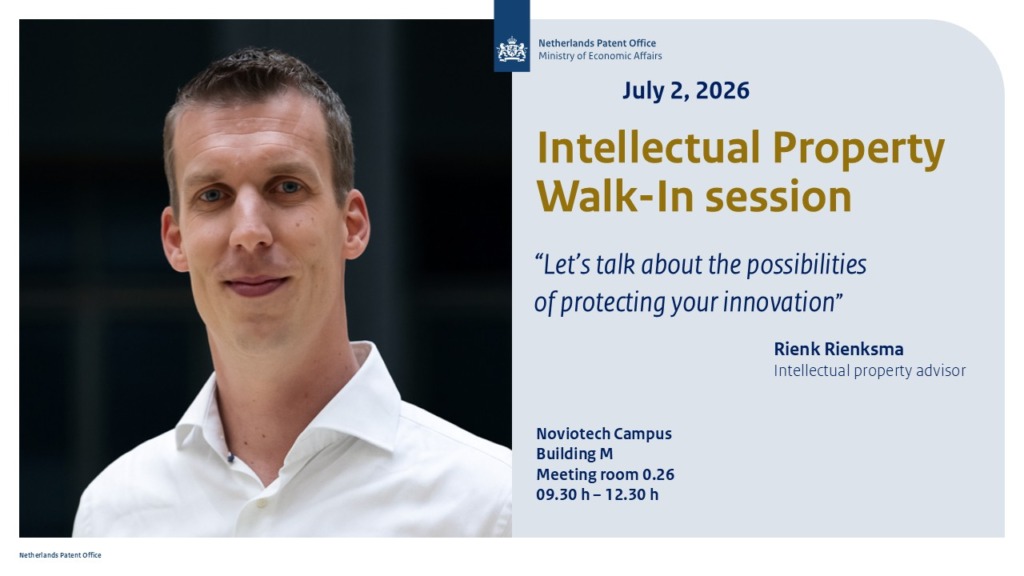
Monthly IP walk-in for health & hightech entrepreneurs. Are you a startup or SME in the health or hightech sector? Every month, we host a free walk-in session where you can get expert advice on Intellectual Property (IP).

Why IP matters

As an entrepreneur, protecting your ideas, technologies, and brand is crucial. Whether you’re developing medical innovations, software, or high-tech devices, having a solid IP strategy can help you secure funding, attract partners, and stay ahead of the competition. From patents and trademarks to design rights and trade secrets—knowing your options can make all the difference.

Meet Rienk Rienksma – IP Advisor at RVO

Rienk is an Intellectual Property advisor at the Netherlands Patent Office. The Netherlands Patent Office is the official body responsible for granting patents in the Netherlands. It supports startups and SMEs with questions about IP rights in the broadest sense—whether it’s patent protection, trademarks, or understanding how to safeguard your innovation roadmap.

The advice is confidential, free of charge, and completely independent—no commercial interests involved.

You’re welcome to just walk in, or if you prefer, you can make an appointment in advance.

Contact Rienk Rienksma: rienk.rienksma@rvo.nl

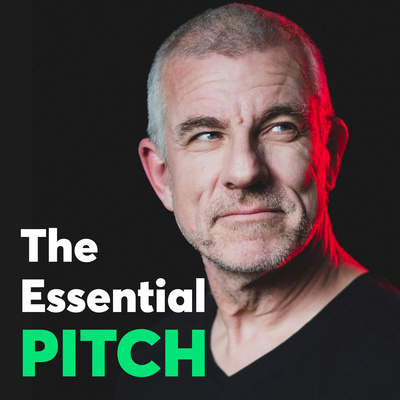
Master the Art of Pitching with International Coach David Beckett!

Back by popular demand, this workshop is your opportunity to learn the secrets of crafting a winning pitch from one of the best in the business. David Beckett, an internationally renowned pitch coach, has helped over 2.500 startups and scaleups secure more than €460 million in funding. Now, he’s ready to help you sharpen your pitch skills in a dynamic, hands-on session.

In this fast-paced workshop, you’ll dive into practical techniques to build a compelling storyline, make your message clear and unforgettable, and deliver a powerful opening and closing. With fun, interactive exercises, you’ll practice each step and gain confidence in presenting your pitch with impact.

Plus, you’ll leave with exclusive resources and access to David’s Pitch App, designed to help you perfect your pitch long after the workshop ends. Whether you’re preparing a pitch for investors, clients, or networking events, this is your chance to stand out and make a lasting impression.

Don’t miss this chance to elevate your pitch game and join a community of ambitious professionals!

Afterwards, you’ll receive a selection of materials and access to an App that will help you deliver your winning pitch, handshake pitch and/or elevator pitch

David Beckett Bio

David Beckett is an International Pitch Coach, who has trained over 2900 Startups and Scaleups to win over €490Million in investment. He’s also trained more than 41,000 professionals at companies such as Vodafone, Tommy Hilfiger, PwC and AirFrance KLM, in 33 countries – as well as over 30 TEDx speakers. David is the creator of The Pitch Canvas©, and author of the books Pitch To Win and Long Story Short.

LinkedIn: https://www.linkedin.com/in/davidbeckettpresentationcoach/

Location
Meet&Greet, Noviotech Campus Nijmegen.

Good to know
The workshop is facilitated in English and is free of charge and organised together with The Launch.

Participation in the workshop is free for everyone, including drinks and bites. However, for noshow and cancellations within 24 hours prior to the event, we will charge a fee of 15 euros (excluding VAT) to cover incurred expenses.

De semiconsector is een van de belangrijkste motoren van innovatie in de regio Arnhem-Nijmegen. Met meer dan 7.000 medewerkers, toonaangevende bedrijven en een sterke positie binnen de Nederlandse chipindustrie beschikt de regio over een uniek ecosysteem van kennis, technologie en ondernemerschap.

Om deze kracht verder te versterken, brengt Lifeport Semicon Industries (LSI) bedrijven, kennisinstellingen en andere partners samen. Het netwerk stimuleert samenwerking, kennisdeling, innovatie en talentontwikkeling binnen de semiconductorsector. Door elkaar regelmatig te ontmoeten, ontstaan nieuwe verbindingen, gezamenlijke initiatieven en kansen voor groei.

Netwerkbijeenkomst bij Doeko

Op donderdag 2 juli organiseert Lifeport Semicon Industries een nieuwe netwerkbijeenkomst bij Doeko in Weurt. Tijdens deze bijeenkomst staan samenwerking, technologische ontwikkeling en het delen van kennis centraal.

Het programma bestaat onder andere uit:

  • Een introductie van Doeko en een kijkje achter de schermen van het bedrijf.
  • Presentaties van bedrijven over hun technologische roadmap en toekomstplannen.
  • Een vooruitblik op de Roadmap Day die later dit jaar samen met de Radboud Universiteit wordt .georganiseerd.
  • Een rondleiding door Doeko.
  • Volop gelegenheid om te netwerken met professionals uit de semiconsector.

Naast directieleden zijn ook innovatie- en technology managers van harte welkom om deel te nemen aan deze bijeenkomst.

Praktische informatie

Datum: donderdag 2 juli
Tijd: 15.00 – 18.00 uur
Locatie: Doeko, Thomas van Heereveldstraat 1, 6551 AK Weurt

Interesse?

De uitnodigingen voor deze bijeenkomst worden persoonlijk verstuurd naar aangesloten bedrijven en relaties binnen het netwerk. Bent u werkzaam in de semiconductorsector en heeft u interesse om deel te nemen aan deze bijeenkomst of kennis te maken met Lifeport Semicon Industries?

Neem dan contact op met Briskr via onze programmamanager Mireille Kinket. We bekijken graag of deze bijeenkomst aansluit bij uw organisatie en sturen u indien mogelijk de uitnodiging toe.

Lifeport Semicon Industries – Strengthening semicon. Accelerating innovation.

Hoe help je mensen langer zelfstandig thuis wonen? Hoe ondersteun je zorgprofessionals die onder hoge werkdruk staan? En hoe zorg je ervoor dat goede ideeën sneller hun weg vinden naar de praktijk?

Dat zijn precies de vragen waar het Digital Health Challenge Lab (DHCL) zich de afgelopen anderhalf jaar op heeft gericht.

Samen met inwoners, zorg- en welzijnsorganisaties, woningcorporaties, gemeenten, kennisinstellingen en ondernemers zijn meer dan 65 knelpunten uit de praktijk opgehaald. Geen innovaties op zoek naar een probleem, maar échte uitdagingen uit de wijk als startpunt voor nieuwe oplossingen.

Van uitdagingen naar oplossingen.

Dat klinkt eenvoudig, maar vraagt om samenwerking tussen organisaties die elkaar niet altijd vanzelfsprekend ontmoeten. Juist daar ligt de kracht van DHCL.

Inmiddels zijn 11 co-creatietrajecten gestart waarin bedrijven en maatschappelijke organisaties samen werken aan innovaties die aansluiten bij de dagelijkse praktijk. Meer dan 100 bedrijven dachten mee of namen deel aan challenge-rondes en innovatievraagstukken.

De eerste resultaten zijn inmiddels zichtbaar. Zo werkt startup We4U samen met woningcorporaties aan een oplossing die mantelzorgers ondersteunt en het sociale netwerk rondom ouderen activeert. Healthy Chronos ontwikkelt samen met Radboudumc een toepassing die gezondheidsdata uit wearables begrijpelijk maakt voor patiënten. En RoboHome onderzoekt met DrieGasthuizengroep hoe robottechnologie huishoudelijke ondersteuners kan helpen om fysieke belasting te verminderen.

Maar misschien nog belangrijker dan de cijfers zijn de verbindingen die zijn ontstaan. Ondernemers komen in contact met zorgorganisaties, woningcorporaties en gemeenten. Professionals kijken over de grenzen van hun eigen organisatie heen. En innovaties krijgen de kans om zich te ontwikkelen vanuit een concrete vraag uit de samenleving.

Van co-creatie naar impact.

Want het doel is niet om mooie ideeën te verzamelen, maar om oplossingen te realiseren die bijdragen aan een gezonder, zelfstandiger en prettiger leven voor inwoners van onze regio.

Het Digital Health Challenge Lab laat zien dat innovatie niet ontstaat achter een bureau, maar samen met de mensen die dagelijks met deze uitdagingen te maken hebben.

De volgende fase is inmiddels aangebroken. Naast het ontwikkelen en valideren van innovaties ligt de focus steeds meer op het opschalen van succesvolle oplossingen, het delen van kennis en het duurzaam verankeren van deze manier van samenwerken in de regio.

Van innovatie naar opschaling. Samen maken we het verschil.

Dank aan alle partners die hier dagelijks aan bijdragen. Samen bouwen we verder aan een regio waarin maatschappelijke uitdagingen niet alleen worden besproken, maar ook daadwerkelijk worden omgezet in concrete oplossingen.

Houd digitalhealthchallengelab.nl in de gaten voor nieuwe challenges, partners en de resultaten. 

Een Nederlandse chip die hartfilmpjes, hersenactiviteit en spierbewegingen opvangt met tien keer minder stroomverbruik dan de concurrentie. Sencure BV uit Nijmegen maakt zich op voor de marktintroductie begin 2027. Algemeen directeur Dick van Waes: ,,We lopen twee generaties voor.”

Van ziekenhuiskast naar pyjama

De chip van Sencure werkt als een uiterst zuinige versterker. Elektrische signalen van de huid — van een hartfilmpje tot hersenactiviteit en spiersamentrekkingen — worden met hoge kwaliteit opgepikt, zonder dat er een apparaat aan het stopcontact hoeft. Dat opent deuren die tot voor kort gesloten bleven. ,,Voor een goed hartfilmpje moest je naar het ziekenhuis. Met onze chip kunnen patiënten thuis blijven”, legt Van Waes uit.

Het bedrijf ontwikkelde een gepatenteerde techniek die ook met een matig huidcontact nog hoogwaardige metingen doet. Daardoor hoeven elektroden niet meer met plakkers op precies de juiste plek. Een Nederlandse start-up verwerkte de sensoren in een pyjamaatje voor kinderen met astma. ,,Onze chip meet op de borstkas hoe zwaar het middenrif moet werken. Het kind weet niet eens dat er gemeten wordt.”

Nijmegen als chip-hotspot

Sencure heeft zijn wortels in Noord-Nederland, maar sinds januari 2025 zit het bedrijf op de Novio Tech Campus in Nijmegen. Daar zit de grootste groep chipontwikkelaars van het land, met NXP, Nexperia en Ampleon als spin-offs van het oude Philips. De directeur ziet Nijmegen als onmisbare schakel in de Nederlandse halfgeleiderindustrie naast Eindhoven, Twente en Delft. ,,Je hebt hier een groot netwerk van mensen die weten wat ze doen.”

De combinatie van biomedische en elektronische kennis is wat Sencure uniek maakt. Twee grote Amerikaanse concurrenten maken vergelijkbare chips, maar die zijn lastig te integreren en verbruiken veel stroom. ,,We lopen een paar generaties voor op de concurrentie.”

Toepassingen tot ver buiten de zorg

De toepassingen reiken veel verder dan de medische wereld. Sencure praat met gaming-bedrijven over headsets die de alertheid van professionele gamers meten. Met een partij die tandenknarsen tijdens de slaap registreert én via een klein stroomschokje stopt. Met bouwbedrijven, defensie, luchtvaart en MARIN. Zelfs rolstoelbesturing via gedachten komt binnen bereik. ,,Dat bestaat al met algoritmes, maar wij maken het veel eenvoudiger met een simpele hoofdband.”

Koffie in de regio

Sencure telt nu 25 medewerkers en wil binnen een jaar verdubbelen. De algemeen directeur nodigt ondernemers uit de regio Arnhem-Nijmegen nadrukkelijk uit voor een gesprek. Vooral bedrijven die voor derden apparaten ontwikkelen — denk aan Demcon in Enschede of EPR in Nijmegen hoog op zijn lijstje. ,,Schroom niet. Of je nu in de bouw zit, defensie of luchtvaart, die chip kan in heel veel producten.”

Het werkende prototype is af, het definitieve ontwerp gaat deze maand naar de fabriek. ,,Het licht aan het einde van de tunnel is in zicht”, besluit de bevlogen directeur. Begin 2027 moet de chip commercieel beschikbaar zijn — een Nederlands product dat in Nederland wordt geproduceerd én getest.

www.sencure.com

Dit artikel is gemaakt voor Kijk op Arnhem-Nijmegen.

Op 11 juni 2026 verandert Openluchttheater De Goffert in Nijmegen in het decor van een avond vol ruimtevaart, wetenschap, innovatie en grote dromen. Tijdens De Nacht van de Ruimte gaan inspirerende sprekers in op thema’s als moonshots, duurzaamheid, klimaatverandering, slaap en de toekomst van onze samenleving.

Met bijdragen van onder andere NASA/ESA-expert Philippe Schoonejans, transitiedeskundige Jan Rotmans en klimaatwetenschapper Heleen de Coninck belooft het een bijzondere en extra uitgebreide editie te worden.

Benieuwd naar het volledige programma en tickets? Bekijk alle informatie via De Nacht van de Ruimte 2026

Goede ideeën ontstaan vaak precies op het snijvlak van talent, nieuwsgierigheid en ondernemerschap. Daarom delen we graag deze oproep van INNOVATE: de zoektocht naar de Innovatiefste Student van Nederland 2026 is gestart.

Werk jij als student aan een innovatief idee, startup, onderzoek of project met impact? Of begeleid jij als ondernemer, startup of organisatie een student met een bijzonder initiatief? Dan is dit hét moment om die innovatie zichtbaar te maken.

De challenge is bedoeld voor studenten, afstudeerders en studententeams uit heel Nederland die bijdragen aan een slimmere, duurzamere of socialere toekomst. Juist de verbinding tussen onderwijs en ondernemerschap levert vaak verrassende innovaties op; van slimme health-oplossingen tot hightech toepassingen en maatschappelijke vernieuwing.

Deelnemers maken kans op landelijke zichtbaarheid, coaching en mooie prijzen, waaronder een volledig verzorgde innovatiereis naar Silicon Valley of SXSW London 2027. Eerdere deelnemers groeiden door naar succesvolle startups, nieuwe samenwerkingen en waardevolle connecties binnen het innovatie-ecosysteem.

Meer informatie en inschrijven via (aanmelden kan tot 30 juni):
Innovatiefste Student van Nederland 2026

Monthly IP walk-in for health & hightech entrepreneurs. Are you a startup or SME in the health or hightech sector? Every month, we host a free walk-in session where you can get expert advice on Intellectual Property (IP).

Why IP matters

As an entrepreneur, protecting your ideas, technologies, and brand is crucial. Whether you’re developing medical innovations, software, or high-tech devices, having a solid IP strategy can help you secure funding, attract partners, and stay ahead of the competition. From patents and trademarks to design rights and trade secrets—knowing your options can make all the difference.

Meet Rienk Rienksma – IP Advisor at RVO

Rienk is an Intellectual Property advisor at the Netherlands Patent Office. The Netherlands Patent Office is the official body responsible for granting patents in the Netherlands. It supports startups and SMEs with questions about IP rights in the broadest sense—whether it’s patent protection, trademarks, or understanding how to safeguard your innovation roadmap.

The advice is confidential, free of charge, and completely independent—no commercial interests involved.

You’re welcome to just walk in, or if you prefer, you can make an appointment in advance.

Contact Rienk Rienksma: rienk.rienksma@rvo.nl