Green52: turning waste heat into power
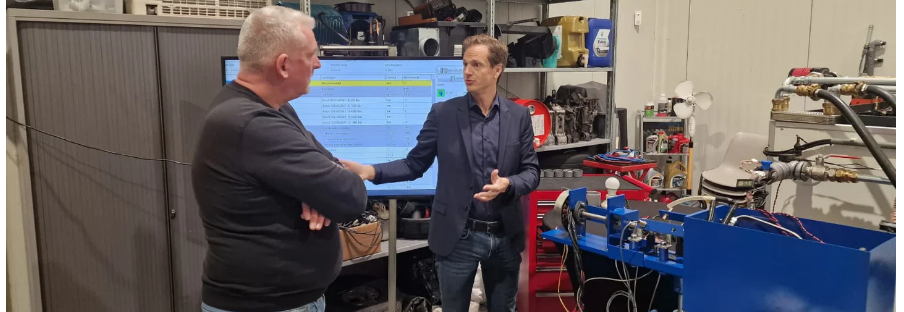
Every industrial process produces heat. In many cases, that heat is useful, up to a point, after which, it becomes waste. Too low in temperature to be reused efficiently, too difficult to capture, and often simply released. For Green52’s Wim Essing, that overlooked category of energy is exactly where the opportunity lies.
With a background in automotive engineering, engine tuning and high-performance technology, Essing has spent most of his career pushing technical systems to their limits. “I’ve always been fascinated by the physical boundaries of technology”, he says. That curiosity led him to a striking physical anomaly in a specific temperature range. By using that anomaly, Essing has developed a thermodynamic generator that can convert low-grade waste heat into electricity. The first prototype is running. Now the challenge is to turn a promising proof of concept into a scalable technology. And Briskr & the BANN network have helped him to take the next steps.
Recovering lost energy
The idea behind the machine is simple to explain, but technically complex to realize. Many industrial processes generate heat at temperatures that are too low for existing conversion technologies. Above roughly 200 degrees Celsius, there are established ways to use heat to generate power. Below that point, the options become much more limited.
Essing’s technology is designed for exactly that lower temperature range. “I put 60-degree heat in, and create electricity. It’s a unique solution”, he says. In its current form, the prototype can use a temperature difference, for example cooling water from 60 to 40 degrees Celsius, to activate the anomaly in the material. That creates pressure, which can then be converted into electricity.
The prototype has run and has been independently assessed, but it is still far from a commercial product. The current machine weighs around 5,500 kilos and produces only about 1,000 watts. The next question is whether it can be engineered into something smaller, stronger, cheaper and durable for industrial use.
From prototype to industrial application
The potential applications are broad: data centers, aluminum foundries, food processing plants, power stations and large industrial sites all produce heat that is often removed through air or water cooling and then lost.
Essing imagines a future in which that heat forms the basis for renewed electricity. “This is essentially ‘free’ electricity. Of course, there’s the costs of the machine, turning the question into: how long does it operate, and what is the return on investment?”
The prototype has proven the technical principle to work, but the stresses inside the machine are high. Components are exposed to significant forces, and the team now needs to understand how materials behave over time. “We now have to find out how long the system can keep running under these conditions”, Essing says. Which parts can be bought off–the-shelf? And where is custom engineering needed?
And what level of efficiency is good enough for a commercially viable machine? The environmental benefit may be obvious, but for industry, calculations must also work financially. Essing is clear that perfection is not the goal in the first commercial version. “If we do not recover 50 percent of the waste heat, but perhaps 30 percent, that may still be highly valuable”, he says.
The funding gap between invention and scale
So far, the development has been funded by a group of five private investors. Together, they have put over a million euros into the prototype. The next step is significantly larger. To move from proof of concept to industrial technology, Essing expects that several million euros will be needed for research, engineering, modelling, durability testing and team development.
That makes the project challenging for traditional angel investment. The potential impact is large, but the road to market is long and technically risky. During the BANN session, Essing pitched Green52 to a group of business angels, to learn how investors viewed the opportunity.
What BANN and Briskr brought
The direct investment result was straightforward: zero. Yet the session was far from a disappointment. “Why would you not invest in this?” Essing asked the investors during the conversations. Their answers were honest and insightful. The technology is not yet proven durably. The return on investment is too uncertain at this stage.
For Essing and his investors, that feedback helped sharpen the next step. The project may be very suitable for public funding, European innovation programs or subsidy routes focused on sustainable energy, energy efficiency and grid congestion.
The BANN program helped Essing present the technology to experienced investors and advisers. “It was a very positive experience for me”, he describes. “The support in preparing the pitch was really good.” The process helped him understand what investors still need before stepping in, and several people offered to help explore subsidy opportunities.
Keeping the opportunity in the Netherlands
The ambition is high. At the same time, Essing is realistic. The technology is still at an early readiness level. For now, the company is looking for the right route to continue development. That may involve subsidies, universities and technical partners. To move forward, the company needs people who can help build the organization around the invention: subsidy specialists, technical partners, business developers and eventually a broader engineering team.
And eventually, it needs larger investors. Essing’s preference is clear: he wants the intellectual property and the opportunity to stay in the Netherlands for as long as possible. “But not at all costs, because if we really put a team of people on this, I believe we can make something beautiful”, he says.
Foto: Chris Smits