
DO YOU HEAR WHAT I HEAR?
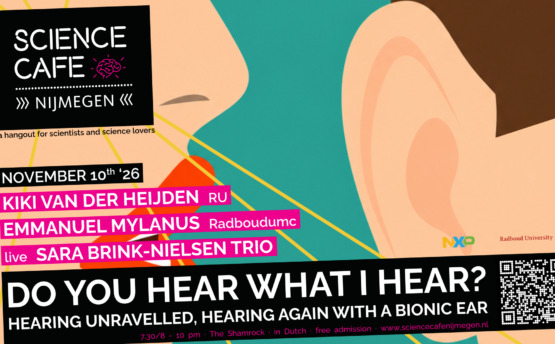
hearing unravelled, hearing again with a bionic ear
In a busy café, you effortlessly pick out a friend’s voice. You can tell where a sound is coming from without turning your head. We often only realise how much work our brain puts into this when our hearing starts to decline. A cochlear implant can then offer a solution by stimulating the auditory nerve directly. Not only does this help people hear, but it also gives scientists insight into how hearing works. How does the brain learn to make sense of a signal so different from natural sound? And what does that tell us about our hearing?
On Tuesday, November 10, the Science Café dives into the science behind natural and artificial hearing. Emmanuel Mylanus, Professor of Otological Implantology at Radboudumc and one of the surgeons who place cochlear implants, will discuss the operating principles of these implants, the differences between children and adults, and their impact on patients. Kiki van der Heijden, assistant professor at the Donders Institute, conducts research in auditory neuroscience. She develops artificial neural networks that process sound much like the brain does, for example to determine where a sound is coming from. This helps us better understand how hearing works and how cochlear implants can be tailored to the way we hear.
Throughout the evening, the trio of Sara Brink-Nielsen (harp), Sacha Palies (double bass) and Billy Prim (drums) will play unconventional jazz: colourful, seductive yet slightly venomous. An invitation to listen with different ears.
scientists/8 pm Kiki van der Heijden (RU) and Emmanuel Mylanus (Radboudumc)
music/7.30 pm Sara Brink-Nielsen Trio
moderator Maïté Tjon A Hie
time Tuesday November 10th 2026, 7.30/8 – 10 pm
venue The Shamrock, Smetiusstraat 17, Nijmegen
admission free admission (no reservation)
language Dutch