Can materials think like the brain?
Can materials function like the human brain? That fundamental question drives the research of Professor Alexander Khajetoorians at Radboud University.
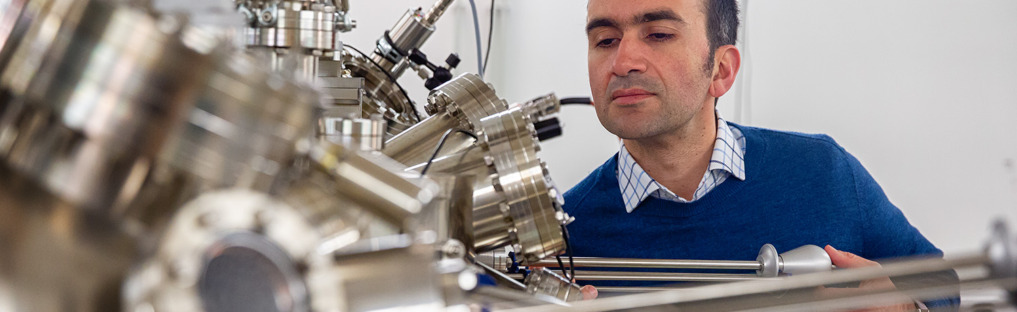
As head of the Scanning Probe Microscopy department, part of the Institute for Molecules and Materials within the Faculty of Science, Khajetoorians explores how materials behave at the most fundamental level, down to individual atoms. Using one of the highest-resolution microscopes in the Netherlands, his team investigates the electronic and magnetic properties of materials to uncover entirely new functionalities.
“We are trying to understand previously undiscovered material properties and use them to develop a new generation of computer technologies,” he explains.
Towards Neuromorphic Computing
Khajetoorians’ work focuses on neuromorphic computing, computer architectures inspired by the structure and functioning of the human brain.
“We need radically more energy-efficient computing,” he says. “Today’s AI systems rely on enormous, energy-consuming data centers. If we continue expand our computing demands, the electricity demands will soon become unsustainable.”
To illustrate the urgency: training an AI system for a self-driving car can already require more energy than producing and operating the car itself.
Neuromorphic computing aims to change that paradigm. Instead of separating memory and processing — as conventional computers do — they try to mimic the brain integrate both, much like neurons and synapses in the brain. The result: faster, adaptive systems with dramatically lower energy consumption.
National efforts in Neuromorphic Computing
During the Lifeport Semicon Event 2026 at Goffertstadion, Khajetoorians was the keynote speaker in the Disruptive Technologies track, where he presented National Efforts in Neuromorphic Computing. As the sole speaker in this parallel session, he outlined how the Netherlands is positioning itself at the forefront of this emerging field.
Beyond energy efficiency, he emphasized broader societal drivers: technological sovereignty, security, and independence from global tech giants and critical supply chains.
“These are strategic questions,” he notes. “If we want Europe to remain competitive and autonomous in AI and advanced computing, we must invest in alternative technologies and new material platforms.”
Building a National Ecosystem: Neuromorphic NL
Khajetoorians has taken a leading role in strengthening collaboration between academia, industry, and government. Together in a national effort, Khajetoorians participated in drafting the white paper Neuromorphic Computing in the Netherlands, laying the foundation for a coordinated national strategy.
The initiative has been embraced by the Dutch Top Sector ICT (now Digital Holland) and translated into a national action plan aimed at accelerating research, innovation, and valorisation in neuromorphic technologies now found as Neurmorphic computing NL (nc-nl.com)
A key component of this effort is the research theme “Materials that Learn”, exploring adaptive materials capable of mimicking synaptic behaviour, while also addressing the responsible and ethical use of such technologies. This theme forms part of the new NWA-ORC 2026 programme of NWO under the Dutch National Science Agenda.
Lifeport as a Semiconductor Powerhouse
Khajetoorians also underlined the strategic importance of the Lifeport Region Arnhem-Nijmegen as the Netherlands’ second semiconductor hub.
“Many people immediately think of Eindhoven and ASML when it comes to semiconductors,” he says. “But this region hosts a powerful ecosystem of semiconductor companies, cutting-edge university research, innovative startups, government partners and educational institutions.”
The Lifeport Semicon Event, he adds, plays a crucial role in making this ecosystem visible and connecting stakeholders around urgent technological and societal challenges.